The Aspirant enters through the yoga, the reading of the Central Doctrine and the study of the Tarot, and performs no rite yet. The nativity study begins in the first week and runs through every grade after it.
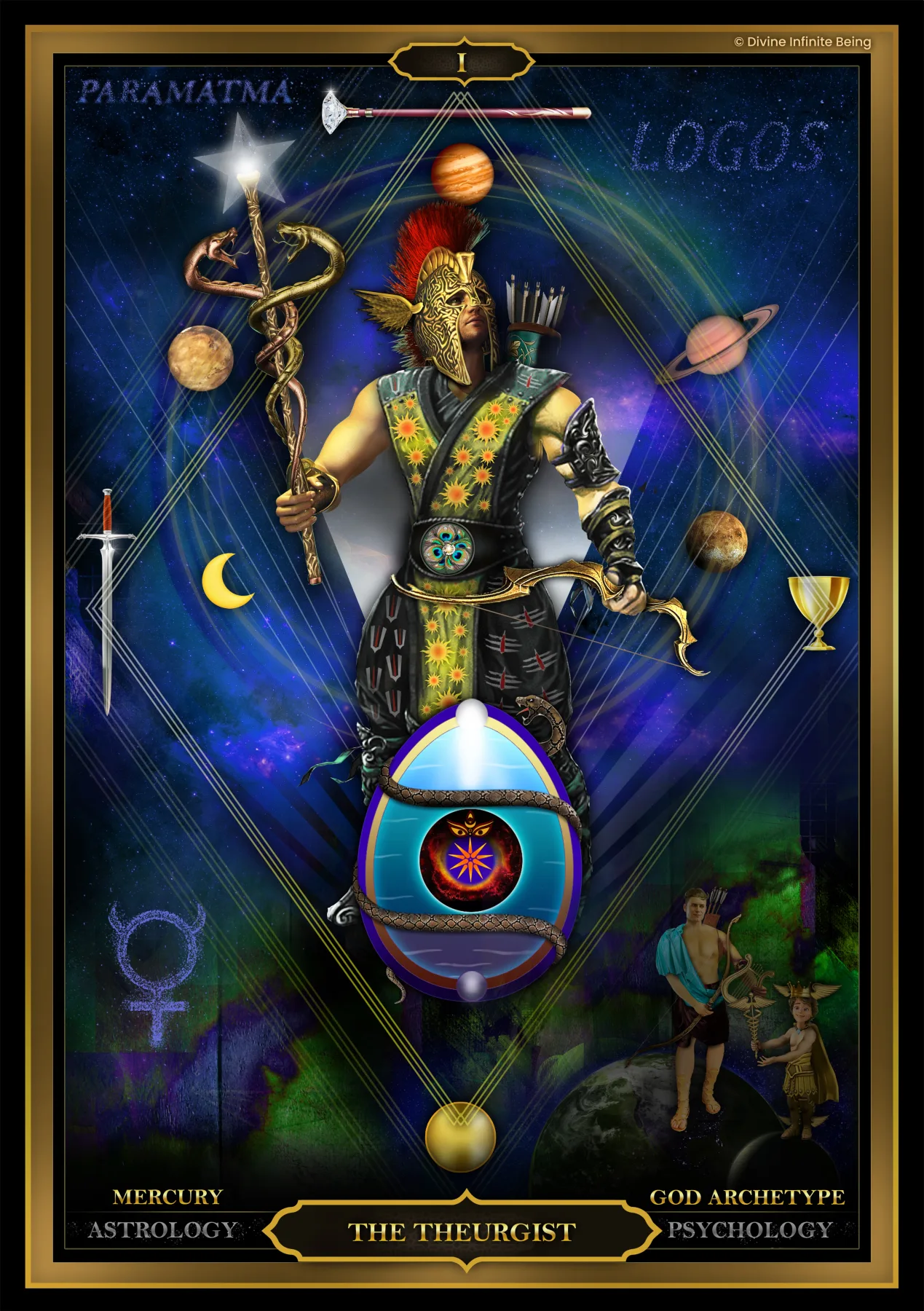
Hermes is the messenger between the worlds, the god of roads, thresholds and boundaries, and the guide of those who cross from one realm to another. In our teaching he presides over the threshold and over the introduction to the mysteries. The planet Mercury is his visible body, and the Theurgist card of the Greater Arcana pictures him together with Apollo.
The first two weeks go to the Preface, the Introduction, Chapters 1 to 4 and Chapter 8 of Ritual Praxis and Instruction, and the next two to Chapters 5 to 7 with the first chapters of the Central Doctrine beside them. From about the fifth week the reading hour belongs to the Central Doctrine in order, with a few gains written in the journal at the end of each chapter. The Divine Arcana Tarot is read in the practice hour, with the throws.
Every chapter has its own open-book test of 3 to 10 questions, about one question for every 2,500 words. Every answer must be correct, and a wrong answer returns the student to the section to reread before the test is taken again. Each student also receives a workbook of the questions of every chapter, without the answers, to mark while reading, so that the reading and the test move together.
Read the chapter, marking the workbook
Take its test
100%Go on to the next chapter
A wrong answer: reread the section
Grade 1: the initiation
The gate of Earth, under Hermes
The work of the Aspirant opens with an initiation that the Head Master, or an officiant he permits, performs for you once, live, in person or by video. You book its date and hour in your Backoffice, at a time when you can be alone in a quiet room for an hour.
The officiant performs the regular banishing of our School, opens the gate of Earth and invokes Hermes, the patron of the grade. You keep the breaths and the silences with the officiant and speak one sentence, your word of entry into the work of the grade. You need no instrument and perform no part of the rite.
The god is invoked into the temple and never onto or into you, and you are free to step out of the work at any point. The initiation opens the work of a grade you hold, and no title is given for an experience.
What you prepare
Three things.
A booked date and hour, chosen in your Backoffice
A quiet room where you are alone and undisturbed for an hour
Your journal, to write the record of the rite after it, with your word of entry as you spoke it
The grades climb through the elements: Earth, Air, Water, Fire, then Spirit. The sixth grade has no initiation of this kind.
Grade 1: the practice
The practice, count by count
Each count below is a rule of the School, stated in Ritual Praxis and Instruction, Chapter 1, with the chapter and section where the practice is taught.
at least 40 recorded sessions
Raja KundaliniEach in the order of a session (RPI Ch. 5 §5.12), with a few lines in the journal after each: which exercises, how long, how the breath held, what was felt in the body.RPI Ch. 5 to 7, §5.12 · Appendices F and I
4 days
The four days of learning the setThe physical set learned from the figures of Chapter 6, counted within the 40.RPI Ch. 6, §6.6.6
at least 20
Full performances of the setCounted within the 40, since a session may carry the full set or its first exercise alone.RPI Ch. 5, §5.12 · Ch. 6
at least 12
Meditations of UnityChapter 5, §5.9.RPI Ch. 5, §5.9
at least 8
Sittings in the Śiva stateChapter 5, §5.10.RPI Ch. 5, §5.10
at least 7
Condensed ascents with the descentThe seven embodiments, Chapter 7, §7.6. The deep ascent of seven weeks is optional and is never required in a grade.RPI Ch. 7, §7.6
every prescribed throw once
Tarot throwsRecorded by position with a short interpretation in the Aspirant’s own words. The time table counts 12, one full study day each.The Divine Arcana Tarot, Ch. 38 and 40 · RPI Ch. 2, §2.5
from the first week
The nativityThe Advanced Report from AwakenedSky.com, free with the code in the Backoffice, its pages kept in the journal, beginning with the Ascendant, the Sun and the Moon (Chapter 8).RPI Ch. 8
Grade 1: the reading
The reading, chapter by chapter
Every chapter the Aspirant reads, book by book, with its length, its time at 200 words a minute and the size of its open-book test.
Ritual Praxis and Instruction: the Preface, How to Use and the Primer
10 chapters, 102,094 words, about 8.5 hours in the reading hour. 10 chapter tests, 43 questions.
PrefaceThe Oracle and the Sun8,187 wordsabout 40 minutesTest: 3 questions
IntroductionHow to Use This Manual8,851 wordsabout 45 minutesTest: 4 questions
Chapter 1The Order of Practice: The Six Grades, Their Patrons and the Time the Work Takes11,788 wordsabout 1 hourTest: 5 questions
Chapter 3The Body of the Theurgist: Sleep, Table, Training and the Fast4,690 wordsabout 25 minutesTest: 3 questions
Chapter 4Safety, Discernment and the Ethics of Possession12,809 wordsabout 1.1 hoursTest: 5 questions
Chapter 5Raja Kundalini: Raja Yoga and the Seat of the Witness15,741 wordsabout 1.3 hoursTest: 6 questions
Chapter 6Kundalini Yoga: The Physical Set and the Breath of Fire12,261 wordsabout 1 hourTest: 5 questions
Chapter 7Tantric Kundalini: The Seven Embodiments and the Ladder of Light15,563 wordsabout 1.3 hoursTest: 6 questions
Chapter 8The Nativity Studied from the First Day4,863 wordsabout 25 minutesTest: 3 questions
Central Doctrine
67 chapters, 855,165 words, about 71.3 hours in the reading hour. 67 chapter tests, 344 questions.
Front matterPrefaces and Appreciations5,824 wordsabout 30 minutesTest: 3 questions
Front matterAuthorial and Doctrinal Clarification5,329 wordsabout 25 minutesTest: 3 questions
Front matterThreshold: Awakening into the Starry Realm829 wordsabout 5 minutesTest: 3 questions
Chapter 1The Grand Introduction: The School of Our Divine Infinite Being and a Note to the Aspirant9,993 wordsabout 50 minutesTest: 4 questions
Chapter 2The Canonical Statement of the Tradition10,364 wordsabout 50 minutesTest: 4 questions
Chapter 3We Are a Polytheistic School of Modern Theurgy: The Perennial Philosophy, the Absolute Unity, the Platonic One and the Many Veils10,628 wordsabout 55 minutesTest: 4 questions
Chapter 4A Mystery Tradition: From the Ancient Mysteries to Iamblichus and the School, and the Framework of Practice13,527 wordsabout 1.1 hoursTest: 5 questions
Chapter 5Carl Jung, Wolfgang Pauli and the Jung-Pauli Conjecture10,033 wordsabout 50 minutesTest: 4 questions
Chapter 6The Monad, the Dyad and the Opposition in All Things: The Tao10,424 wordsabout 50 minutesTest: 4 questions
Chapter 7Symbols and Numbers: Gateways Between the Worlds15,291 wordsabout 1.3 hoursTest: 6 questions
Chapter 8The Map of the Psyche: The Unconscious, the Shadow, Virtue and the Transpersonal Egg14,652 wordsabout 1.2 hoursTest: 6 questions
Chapter 9Archetypes and Platonic Forms Are One: Parallels East and West11,051 wordsabout 55 minutesTest: 4 questions
Chapter 10The Mandala Archetype: Self and God, Ātman and Puruṣa-Ātman10,235 wordsabout 50 minutesTest: 4 questions
Chapter 11Synchronicity, Aion and the Voice of the World10,739 wordsabout 55 minutesTest: 4 questions
Chapter 12Quantum Mechanics and the Two Great Pictures: From Pauli to Stapp9,034 wordsabout 45 minutesTest: 4 questions
Chapter 13The Volitional Will and the Divine Will9,324 wordsabout 45 minutesTest: 4 questions
Chapter 14The Probe and the Answer: The Intervention of Consciousness7,388 wordsabout 35 minutesTest: 3 questions
Chapter 15Complementarity, Uncertainty and the Squeeze of New Knowledge9,480 wordsabout 45 minutesTest: 4 questions
Chapter 16Oscillation, the Zeno Effect and Templates for Action: The Bodily Trace of the Will10,621 wordsabout 55 minutesTest: 4 questions
Chapter 17Quantization, the Countable Alphabet and Statistical Causation10,331 wordsabout 50 minutesTest: 4 questions
Chapter 19Nested Causal Diamonds: The World Line and the Future in the Past10,381 wordsabout 50 minutesTest: 4 questions
Chapter 20Our Earth Is Alive: The Anima Mundi, Hecate and the Station of Reception9,394 wordsabout 45 minutesTest: 4 questions
Chapter 21Gravity and Consciousness; Śiva and Śakti in the Zero-Energy Universe12,026 wordsabout 1 hourTest: 5 questions
Chapter 22The Quantum Vacuum, the Hat and the Mandala of the Greater Universe: Psyche = Singularity14,206 wordsabout 1.2 hoursTest: 6 questions
Chapter 23The Infinitely Hot Cosmic Horizon, the Backreaction, the Hermetica and the Bhāgavatam11,335 wordsabout 55 minutesTest: 5 questions
Chapter 24The Horizon Mirrored in the Self: The Collective Unconscious of the Multiverse and the ochēma10,841 wordsabout 55 minutesTest: 4 questions
Chapter 25Ba, Ka and the Divine Double: The Observables in the Hat9,792 wordsabout 50 minutesTest: 4 questions
Chapter 26The Personal Daemon, the Two Alignments and the Cultivation of Virtue17,550 wordsabout 1.5 hoursTest: 7 questions
Chapter 27The Grand Integration of the Chaldean Epoch and the Mystical Numbers Four and Seven15,208 wordsabout 1.3 hoursTest: 6 questions
Chapter 28Astrology's Lineage and Its Evidence: From the Babylonian Omens to the Living Wheel12,072 wordsabout 1 hourTest: 5 questions
Chapter 29The Solar Ātman: The Conscious Sun and Why the School's Astrology Is Solar and Tropical12,694 wordsabout 1.1 hoursTest: 5 questions
Chapter 30The Light That Is Instruction: The Timeless Photon, the Infinite Light and the Process of Manifestation10,767 wordsabout 55 minutesTest: 4 questions
Chapter 31The Body of Light: The Luminous Vehicle and Awareness from the Light18,445 wordsabout 1.5 hoursTest: 7 questions
Chapter 32The Planets Are the Gods' Visible Bodies: Operators, Fate and Providence16,879 wordsabout 1.4 hoursTest: 7 questions
Chapter 33The Evolution of Brahman: From the Vedic Brāhmaṇas to Quantum Energy10,420 wordsabout 50 minutesTest: 4 questions
Chapter 34Sāṃkhya and Advaita Vedānta: Non-Dual Reality without Dissolution14,010 wordsabout 1.2 hoursTest: 6 questions
Chapter 35Animism, Viṣṇu, Kṛṣṇa and Goloka Vṛndāvana through the Lens of the Multiverse13,992 wordsabout 1.2 hoursTest: 6 questions
Chapter 36Achintya-Bhedābheda: The Boundless God Within, and the Non-Duality of the Gospel of Thomas11,831 wordsabout 1 hourTest: 5 questions
Chapter 37Perennialism and the Śākta Foundation of the School's Eastern Practice: The Goddess in Many Cultures and Sri Ramakrishna13,799 wordsabout 1.1 hoursTest: 6 questions
Chapter 38Co-Equal God and Goddess within the Parental Monad, the Cosmic Mother13,428 wordsabout 1.1 hoursTest: 5 questions
Chapter 39Nut, Śakti, Kālī, Hecate and Artemis: The Cosmic Soul and the Milky Way11,654 wordsabout 1 hourTest: 5 questions
Chapter 40Ecstatic Union, Not Cosmic War: The Abrahamic and the Hindu-Orphic Cosmos9,761 wordsabout 50 minutesTest: 4 questions
Chapter 41Eros and the Solar Sacrament of the Sacred Erotic13,885 wordsabout 1.2 hoursTest: 6 questions
Chapter 42Conscious Realism, Conscious Agents and the Hierophant: How the Gods Are Real17,742 wordsabout 1.5 hoursTest: 7 questions
Chapter 43Raja Kundalini: The Preparation of the Vessel16,238 wordsabout 1.4 hoursTest: 7 questions
Chapter 44Co-Equal Feminine and Masculine in the Rite: Knower and Womb, Center and Sphere7,166 wordsabout 35 minutesTest: 3 questions
Chapter 45Quantized Pair Potentials, the Torus, Heart-Brain Coherence, Divination and the Ritual Praxis13,373 wordsabout 1.1 hoursTest: 5 questions
Chapter 46Taking the Shape of the Gods: Celestials, Divine Intelligences and the Offered Persona16,070 wordsabout 1.3 hoursTest: 6 questions
Chapter 47Tuning into the Divine Double: Quantum Computation, the Zeno Effect, Decoupling and the Unbinding of Fate14,213 wordsabout 1.2 hoursTest: 6 questions
Chapter 48True Intention: Destiny, Guidance and Manifestation in a Life10,547 wordsabout 55 minutesTest: 4 questions
Chapter 50The Spirits of Nature, the Daemons of Generation, Hecate Queen of Daemons and Kālī17,700 wordsabout 1.5 hoursTest: 7 questions
Chapter 51ROTA: The Wheel, the Divine Arcana Tarot and the Daemonic Forces of the Minor Arcana14,717 wordsabout 1.2 hoursTest: 6 questions
Chapter 52The Platonism of the First Centuries: Philo, Qumran, Early Christianity and the Gospel of Thomas14,319 wordsabout 1.2 hoursTest: 6 questions
Chapter 53Emperor Julian and the Debasing of the Daemon11,942 wordsabout 1 hourTest: 5 questions
Chapter 54Iamblichus Against Sorcery: How the Daemon Became a Demon9,589 wordsabout 50 minutesTest: 4 questions
Chapter 55Purgatory, Exorcism and the Goetic Grimoires: From the Medieval Demonologies to the Modern Orders14,043 wordsabout 1.2 hoursTest: 6 questions
Chapter 57The Soul's Descent, the Inverted Soul and the Integration of the Daemonic; After the Critique: The Theurgist and the Traditions11,223 wordsabout 55 minutesTest: 4 questions
Chapter 58Science and Sacred Scripture, Philosophy and the Poetics of Revelation17,436 wordsabout 1.5 hoursTest: 7 questions
Chapter 59The Book of the Law and the Dawn of the New Aeon: Nuit and Hadit, the Circumference and the Center22,232 wordsabout 1.9 hoursTest: 9 questions
Chapter 60The Unveiling of the Twentieth Century and the Solar Register of the New Aeon: The Khu, the Khabs and the Zero17,017 wordsabout 1.4 hoursTest: 7 questions
Chapter 61The Personal Face of Our Divine Infinite Being: Kṛṣṇa, Christ, Three Texts for the Aspirant, and Iamblichus Our Teacher14,979 wordsabout 1.2 hoursTest: 6 questions
Chapter 62The Three Highest Forms: Beauty, Justice and Truth: The Ethic of the Theurgist29,002 wordsabout 2.4 hoursTest: 10 questions
The journal stays with the student. At the end of each of the first five grades its pages are scanned with a phone into one PDF and sent from the Backoffice, and the Head Master returns his notes with the title of the grade. The examination of a journal takes weeks, and no table counts them.
We test what can be tested, careful reading and a practice that has been kept. No student is tested magically, and no title is given for an experience, a vision or a power.
The Mystery School takes students from the Summer Solstice 2027.