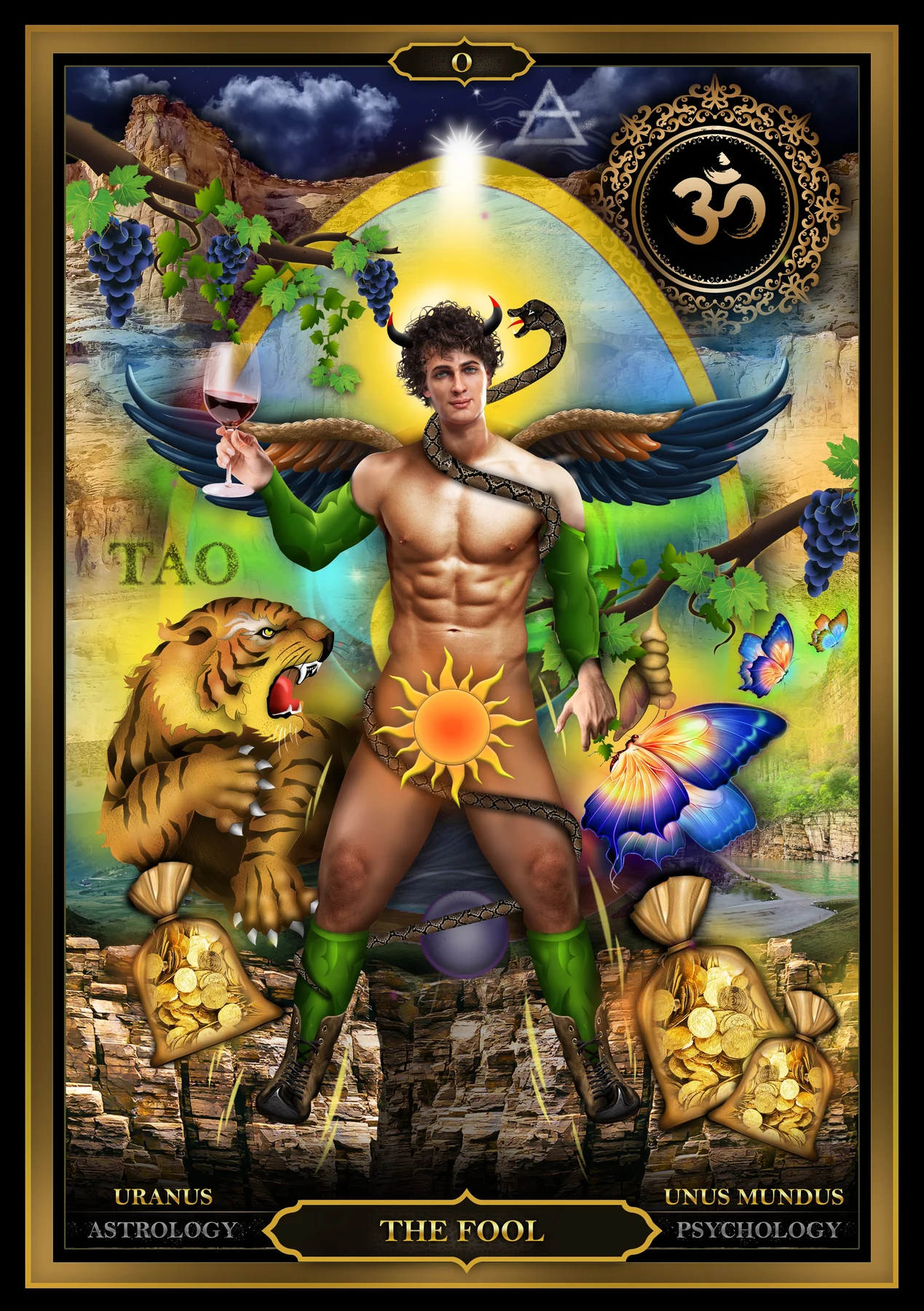
"I am one. Our Divine Infinite Being Identical as Self and separated as Divine throughout the Cosmos." — The Invocation of Our Divine Infinite Being
"…all things have been generated from one Fire." — The Chaldean Oracles, fr. 10 (trans. Majercik)
In the modern School of Our Divine Infinite Being, we stand within a vast spiritual ecology composed of interwoven agencies of archetype and form, intelligences, and mysteries. This is a path populated not only by human seekers, but by daemonic spirits, by the planetary gods and their operators, by theurgic forces, and by symbolic systems that speak to the soul through dream, ritual, and revelation. Our practice draws freely from both Eastern and Western traditions, from the cosmological poetics of the Upaniṣads to the ritual architectures of the Hermetic and Neoplatonic schools, from the depth psychology of Jung to the devotional surrender of the bhakta. It reaches from Tantric sādhanā to the Tarot Arcana and the many planetary and solar signatures of the zodiacal wheel. In our sanctuary all these forms have life.
Because we operate within such a richly populated spiritual universe, we must draw the circle inward. Without an ontological center even sacred multiplicity fragments, theurgy becomes disconnected enchantment, archetypes drift into abstraction and devotion dilutes into aestheticism. To remain grounded, worshipping, we must return to that which binds the real together, a central ontological schema of divine truth. This schema arises from that necessity and affirms the sacred manifold. It holds that all powers, all archetypes, all daemonic mediators, and all rituals must orbit a core reality.
That center is our Divine Infinite Being, and everything that lives in our sanctuary lives in relation to it and to everything else. We draw it as an atlas is drawn, in three layers laid one over the other. First comes the territory, the heights of being from the summit, where the one Real stands, down through seven orders to the child at the foot, who is the theurgist and who is you. Then come the roads, the relations that run between those heights and carry what each order gives to the next. And last comes the journey, theurgy itself, in which the whole map is prayed downward every day in our Grand Invocation and walked home over a path of years. Each place on this map was founded in its own chapter.
A.1 The Architecture of the Real: To Be Is to Be in Relation
What we offer among the many spiritual worldviews of our age is a corrected and hierarchically structured ontology, one that roots all existence in one Real seen from three standpoints, the impersonal Ground, the archetypal geometry of the Name and the personal God. It sets every god, every daemon, every soul and every stone in its true order beneath that one summit.
Everything in our Cosmos stands as a center held within a circumference, and this one pattern is the ground plan of the whole map. The Singularity and the Cosmic Horizon, the Sun and the two shells of his domain, the Earth and her living envelope, and your own solar center within the star vehicle that surrounds it are each the Parental Monad again at its own scale. What lives between a center and its circumference is their child. We pray this every day in our Invocation, "Immortal Parents sprung from one single unifying source, at once, entangled, present in the child, the Theurgist". The One divides itself for love's sake, for the chance of union, and every order of the Cosmos lives that same division and that same union at its own height. To be is to be held in relation, and the whole of what is, held in relation to itself, is the totality state of existence, our Divine Infinite Being.
Our ontology and our rite cannot be separated. If theurgy is participation through the gods' own tokens (Chapter 4), then it presupposes an order to participate in. If the gods were a crowd of unrelated powers the rite would be a series of transactions with strangers. Because the gods are emanations of one Being, every invocation of a god is also an approach to the One, and the ascent through the gods has a direction.
The map reads in three directions at once. Downward runs procession, the giving of the One through every order to the next, the way the soul came forth and the way our Invocation prays each morning from 'Ehyeh to Protogonos. Upward runs return, the same road walked home, through purification, through the tokens and the ministers and the gods, to the Person and the Ground. And across every height run the two faces of the One World, the psychic and the physical, what each order is known as from within and what it is seen as from without.
A.2 The Map of Relational Being
| Height | Who stands here | Center · circumference | Psychic face · physical face | The soul at this height | Gives (procession) | The soul returns by |
|---|---|---|---|---|---|---|
| The summit — Ground | Our Divine Infinite Being in itself: Brahman, the One beyond Being, Ein Sof and the Ayin, the one Fire | Before center and circumference; the Zero | The Unus Mundus, neutral between psyche and matter · imaged only, in the vacuum at the floor of the physical world | The transconscious depth beneath the observing "I" | Remains undivided in all that proceeds | Silence; 'Ehyeh, which opens and closes every rite |
| The summit — Geometry | Infinite, Divine, Being: the Mandala of the Name, the Immortal Parents, the Self/God archetype | The Singularity at every point (YHVH) · the Cosmic Horizon (Elohim); Being between (YHVH-Elohim) | Ātman and Puruṣa-Ātman · the Singularity, the horizon and spacetime (Ch 22–24) | Ātman at the center; the Divine Double at the circumference | Divides for love's sake; holds and keeps without loss | Recognition of the center as the circumference |
| The summit — God | Kālī–Kṛṣṇa, the Parental Monad; Christ, the same face as the Christian tradition knows it | Kṛṣṇa, supra-persona and Observer · Kālī, body of all manifestation, Time and purification | The Beloved who knows and is known · the Multiverse as the Person's body | The child of the Immortal Parents | The self-embrace that is the life of the Cosmos | Love (bhakti); the fifth Name; the Invocation of Our Divine Infinite Being |
| I. The Persona of the Divine | The Dēmiurgós, the Forms, the living gods of every people, the planetary gods as wholes | The Logos, the ordering word · the gods' tokens sown through every level | The archetypes of the objective psyche · the lawful order of nature, its countable alphabet | The intelligible soul; the offered Persona; the force of character | Providence; the gods' goodness down their chains | Taking the shape of the gods; the third intelligence |
| II. The World-Soul | Hecate, source of Soul and threshold, queen of daemons; the astral light; Nut | Hecate at the threshold · Nut, the star-bodied sky | The imaginal stratum, whose personal surface is the Field of Consciousness · the Cosmos as one living body; the Milky Way | The imaginal body, the "first vehicle"; the soul gestated into its threads | Ensouls; gestates souls; carries the Forms into generation | The sixth Name; the lunar work at the threshold |
| III. The House of the Sun | Helios, the Solar Logos (Sol, Apollo); the Zodiac, the Solar Ātman | The Sun · the planetary sphere (Pluto's orbit) and the heliopause (about 120 AU) | The Solar Logos and its twelve personae · 99.86 percent of the system's mass; the tropical year; sunlight | The solar center; Protogonos; the natal Sun as a tuning | Steps the horizon down into the solar order; carries the instruction in light | Helios become Protogonos; the Hermes–Apollo axis; the zodiacal invocations; the Seal of the Crossing |
| IV. The visible gods | The planets as the gods' visible bodies (seven, and three beyond Saturn); the Moon, goddess and luminary | Each god in its orbit · the Moon's medium, on which every operator's work is received | Archetype and operator · body, orbit and phase (the aspects) | The celestial soul (the chart); the operators; the natal Moon | Heimarmenē, the outline of providence in time | The gates and the planetary invocations; Luna clearing the medium |
| V. The daemonic order | The thirty-six faces; Kālī in the place of Physis; the personal daemon, the four guardians, the thirty-six decan daemons; heroes beside | The god of the decan · the ten-degree, ten-day window of the Sun's year | A necessary class of experience, the small card's force · the decan window of the Earth–Sun year | The personal daemon, the Double's natal signature | Binds the soul into a life (holy); administers the test | Cleared to neutral and empowered channels in the Decan Year, the preparation of the temple; then the nativity; then the transits |
| VI. The living Earth and nature | The ensouled Earth; the four elements; the spirits of nature; the feet of the chains | The Earth · her envelope and causal diamond, her soul | The Earth's soul · the biosphere, her year (signs) and her day (houses) | The body; the place and moment of birth | Receives the Sun for every life: heliocentric source, geocentric reception | The pentagrams of the elements in the service of the Dēmiurgós; the disciplines of the body |
| VII. The child, the theurgist | The solar microcosm, wholly descended and whole | The solar center (the observing "I" its point of access) · the ochēma, the body of light, with the Double encoded on it | The Transpersonal Egg · the body, whose cell light is the sign of the body of light | The temporal self | Admission: a thread of the continuum resolved into a life | The whole ascent |
Down the soul's column run the names of one self, the Divine Double at the circumference of the Cosmos, Protogonos in the House of the Sun, the personal daemon among the ministers of generation and the temporal self at the foot.
Each row is a height of being, and the summit is not counted among the orders because it is the whole of which every order is a part. The three rows of the summit are three standpoints of one Real, the Ground, the Geometry and the God. Beneath them the seven orders descend in the order of procession. They descend as Iamblichus gave the order of the superior beings (De Mysteriis I.5–6; Chapter 50), as our Grand Invocation descends from the macrocosm into the microcosm (Ritual Praxis and Instruction, Ch. 25–29), and as the causal diamonds nest one within another from the whole Cosmos down to a single life (Article 8; Chapter 19). Three witnesses so different in kind, a philosopher of the fourth century, a prayer and the geometry of spacetime, give the same order.
The column of what each height gives is the procession read downward, and the column of how the soul returns is the same road read upward, and the return undoes nothing that the procession gave. The binding that the daemons give is holy, and the return clears it until the minister of generation becomes a channel to its god. The heimarmenē of the visible gods is the outline of providence, and the return plays that very score in its highest octave.
The column of the two faces is the One World laid across every height (Article 3). At the summit the Unus Mundus is the Ground itself, neutral between psyche and matter. As the orders descend the one world shows its two aspects ever more distinctly, the archetypes and the lawful order of nature, the imaginal stratum and the living body of the Cosmos, the class of experience and its window of the year, the Earth's soul and her biosphere. At the foot the two meet again as the inner and the outer life of one human being. In every row you can read the psychic face and the physical face of the same order, and neither is the cause of the other. This is the Jung–Pauli dual-aspect monism of our second Pillar (Chapter 5).
And the column of the soul at each height is the Divine Double's names laid on the vertical. We take this up at the child at the foot (A.10). The self you are is present at every height under a name proper to that height. Solar Salvation is the union of the self at the foot with the self at the circumference along the axis that runs through the House of the Sun (Article 16; Chapter 49).
This rule of double placement is what keeps the map from multiplying gods. When you meet Hecate at the threshold of the world, again at the sixth Name of the Invocation and again as queen of the daemons, you are meeting one goddess in her offices. One woman is daughter, mother and teacher in one life, and she is one woman. The gods of our map are wholes, and a whole can be present at several heights without being divided among them. And the same is true of you, who are one self from the circumference of the Cosmos to the body that reads these words.
A.3 The Summit: One Real in Three Standpoints: Ground, Geometry, God
It starts with Brahman, the Absolute Ground, Being itself, prior to every being, prior to psyche, prior even to the idea of unity. It continues with the Mandala of the Name, the field where psyche and cosmos converge, the center of the observer and the structure of experience. It ends with the Parental Monad, where the Absolute reveals itself as Father, Lover, Friend, Child, and Mother, where Being becomes Relation and the final veil is intimacy itself.
This is the Ontological Triad, an ascending spiral of revelation that is lived in experience and conceived in thought. It is a map of the Real, both cosmological and psychological, metaphysical and devotional. It culminates in personhood. The spiral ascends in the order in which the soul comes to know the Real. All three of its turns are the one summit, our Divine Infinite Being, seen first in itself, then as it takes form and last as it turns toward us as Someone.
A.3.1 The Ground: That Which Simply Is
That which simply is: beyond quality, concept, form, or consciousness.
Brahman is pre-consciousness, the nondual ground of all possible reality, deeper than any deity and deeper even than consciousness in the usual sense. It is Nirguṇa (without qualities), prior to thought, form, self, or cosmos. It lies before the One as we count it, as that from which even the One arises. It is most akin in the West to the Ain, the Kabbalistic 0, the Ayin, the Nothing, which the Hermetic Kabbalah, in its three veils of negative existence, placed as a veil still deeper than the Ein Sof, the Without End. In that same scheme the Ain Sof Aur, the Limitless Light, shines as the first radiance of the Ein Sof toward the worlds (Chapters 38 and 59).
Brahman is pre-abstract, deeper than any abstraction, the Void as Fullness, non-conditional being.
- Being Itself, prior to every being in spacetime and causality.
- That from which consciousness arises, deeper than consciousness itself.
- Unmanifest, formless, beyond presence, yet the condition for presence.
This is the level of ontological necessity, for all conditioned things require an unconditioned backdrop and all forms presuppose a formless source. In the language of Plato, which Plotinus made his own, it is "beyond Being" (epekeina tēs ousias, Republic 509b), the One beyond Being. In mystical experience it is the unnameable stillness encountered in the dissolution of false identity, in samādhi, or in the mystic's abyss, and it is what Jung and Pauli referenced as the Unus Mundus. Physics, looking for the bottom of things, finds a fullness that looks like emptiness, the quantum vacuum still teeming at its zero-point energy, and an information prior to space from which, as many physicists now teach, space and gravity arise (Chapter 22). The Ground is mirrored in them.
Its witnesses are these.
- Nirguṇa Brahman (Advaita Vedānta, Chapter 34)
- The One beyond Being (Plato, Republic 509b, and Plotinus)
- Ein Sof, and beyond it the Ayin (Kabbalah, and the three veils of the Hermetic Kabbalah, Chapter 59)
- The one Fire of the Chaldean Oracles (Chapter 1), and the Tao (Chapter 6)
- The background quantum vacuum (physics, as image, Chapter 22)
Why it is real. Mystical states of non-dual awareness, deep samādhi, the dissolution of false identity and the total cessation of duality consistently report this void-presence, and it cannot be seen because it is that by which all seeing arises. What dissolves in such states is false identification, the self taken for its masks, and the witness itself, in every tradition we study, is refined and kept whole (Chapters 8 and 46).
Ontological necessity. All conditioned states require an unconditioned ground, and Brahman is that ground.
Brahman is the condition for conditions, the silence before the Word, the dark radiance that gives rise to light, the deepest depth of our Divine Infinite Being.
A.3.2 The Geometry: The Mandala of the Name
The Archetypal Center and Geometric Unity of Experience
The Singularity is the center of the observer, the Self, the God-Archetype, nearer to us than anything hidden in spacetime.
If Brahman is the ground, then this is the patterned becoming that emerges from it, where psyche and geometry are the actual architecture of reality. Here the three words of our Name each find their office, the Cosmic Horizon (Divine), the Gravitational Singularity (Infinite), and the Eternal Inflating Geometric Order (Being), which we also call the Eternal Inflating Spacetime Geometric Unity. It is here that the Self is revealed as the center of perception, the observer whose act of witnessing gives coherence to form. Here the ancient insight Ātman = Brahman becomes dynamic.
In this stratum we say that psyche = singularity, which is to say that your innermost self is the gravitational center of your cosmos. From this point, the sacred geometry of form and the spatial dimensions of the physical world emanate inwards towards the witness from the boundary. From this point, the vast agency of archetypes arises, the divine intelligences of the whole. From this point, space and time emerge as patterned echoes of meaning.
And not just from this point, but from every point. The Singularity is found here and everywhere, at every point in spacetime and at every point on the spherical cosmic horizon, encoded throughout the whole. Every particle, every soul, every here-and-now is both the center and the whole. This is the layer of Platonic Forms, of Jungian archetypes, of mandalic centers, and of the two-dimensional holographic horizon described in modern theoretical physics.
This standpoint of Being is where the infinite becomes form, and where form retains the memory of the infinite. Standing as the metaphysical middle between matter and spirit, it is the interface where Self and Cosmos become one. Here the psychological, the geometric, and the cosmological are revealed as unified fields. We do not peer at the divine from afar, for we are it. Psyche = singularity is an identity in the full sense we gave it when we defined Psyche = Singularity (Chapter 22), reducing neither matter to mind nor mind to matter. It is one center seen from two sides, so that what physics calls the undivided origin of the world is, looked at from within, the depth of the psyche.
Divine — the Cosmic Horizon, the Womb of Enfoldment. The cosmic horizon is the spherical boundary of our universe as each observer has it, the limit of light, causality and manifestation (Chapter 23). It is the eternal veil at the speed of light, where, in the description of an observer held within, time appears to freeze into eternal presence. This is the razor's edge, a surface of infinite precision, across which spacetime is both projected back into the universe by the inward gravitational backreaction (our usage and Desmond's, Chapter 23) and bounded into the holographic material being, or māyā.
- This horizon encodes all the information within the universe.
- It is lightlike, meaning it exists beyond time, at the edge of all temporality.
- It is the holographic projector, the two-dimensional membrane that contains the fullness of three-dimensional (and higher) space.
In metaphysical terms this is the goddess boundary, the womb of all manifestation. This horizon is immanent, forming a spherical boundary around every point in spacetime. And the universe is projected in from every point around you, toward you at its center. On this surface nothing that has happened is ever lost (Article 9), and because every point has its horizon every soul has its circumference, the ochēma, the horizon mirrored around the soul's own center, on which the Divine Double is kept (Chapters 24 and 25).
She is the field, the veil, the mothering circumference. She is the limit where light ends and being begins.
Infinite — the Singularity, the Point of Identity. The Singularity is right here, at the center of every self-aware being, and everywhere, distributed as the hidden core of all spacetime, as truly as it is found at the heart of black holes and at the Big Bang.
- In physics, it is the place where curvature diverges and general relativity breaks down, a boundary of spacetime and not an object within it.
- In metaphysics, it is the Self, the indivisible observer, the gravitational attractor of coherence and meaning.
- In Jungian terms, it is the God-image, the Mandala, the center of individuation, the unifying archetype.
The Singularity is singular in nature though not in number, and it exists at every point.
- Every point in spacetime contains this center.
- Every boundary on the cosmic horizon mirrors this inner attractor.
- Each soul (jīva) is the whole reflected, a fractal node of the Infinite.
Indian metaphysics knows this same center by two names.
- Kṣīrodakaśāyī Viṣṇu resides in the heart of all beings, witnessing all (Chapter 35).
- Ātman = Brahman, the internal Self as the universal ground (Chapter 10).
This Self is the ontological eye of the storm, still and ungraspable and yet the only true perspective from which reality coheres. All archetypes, all symbolic systems, all mandalas radiate in from the boundary and terminate in divinatory ecstasy of awareness at this center. They are encoded at the circumference and realized, recognized, at the center, which is why the planetary gods are met both as visible bodies in the encompassing sky and as operators within the microcosm (Chapter 32). The Singularity at every point is the identification Psyche = Singularity that I developed with my friend and teacher Timothy Desmond (Chapter 22). In a life its steady reference is the solar center beneath every mood and function, and the observing "I" is the window onto it (Chapters 8 and 29).
Being — the Geometric Fabric of Manifestation. Here geometry, once an abstraction, becomes the medium of embodiment, the structured syntax of the real. It is the result of the Singularity and the Horizon in union and ecstasy. In the language of present-day cosmology it is the eternally inflating spacetime of inflationary cosmology (Chapter 19), our Eternal Inflating Spacetime Geometric Unity.
- The geometry of being is sacred because it is the only possible mode by which the Infinite becomes patterned and finite.
- Every form, every ratio, every sound and shape is a vibration of archetype across the fabric of spacetime.
From the Singularity (psyche) through the Horizon (Śakti), geometry is born, curved space and time, light and the gravitational attractors. This is the world we see, a tapestry woven of Platonic Forms and divine archetypes of meaning, projected across māyā, the matrix-field of relationship and form. And when geometry is born it is born in each of us too, as the bulk of a life, the lived world into which threads are admitted from the already-structured continuum (Chapters 19 and 24).
The Geometry gathers into five functions, each with its scientific expression in the terms we fixed in Chapters 22 and 23. To them we add a sixth, Light, because the instruction that light carries runs through all three terms of the Name (Article 10; Chapter 30).
| Function | Scientific expression | Metaphysical correlate | Significance |
|---|---|---|---|
| Boundary condition | Two-dimensional holographic event horizon (the cosmological event horizon; the holographic principle) | Śakti / Kālī / Shekhinah | All the Cosmos is encoded at the spherical boundary |
| Central point | Singularity in general relativity (where the theory's description fails) | Self / Ātman / Kṣīrodakaśāyī Viṣṇu | The core of each soul and of all reality |
| Geometry of space | Emergent from entanglement (Van Raamsdonk, 2010; ER = EPR, Maldacena and Susskind, 2013), with spin foam (loop quantum gravity) as another candidate picture | Sacred geometry / Platonic Forms | The field of patterns |
| Observer | Non-local witness / central frame | Jungian Self / Mandala / Witness | Source of coherence; Logos |
| Manifestation | Projection from the boundary | Māyā / Yoga Māyā | Field of becoming |
| Light | Zero proper time along a null path; no rest frame for the photon; light as instruction, its resolution delayed until interaction (McKinley's principle; Chapter 30) | The Infinite Light (Ain Sof Aur); the Logos as light | The relation delivered whole, realized in time |
You are the center of the Cosmos and the eye of its field, the child of its womb, its seed and its source.
The three words of the Name hold in every register in which we speak, in the Cosmos and in the soul, in the language of WaveForm, in the light and in the solar microcosm, in our Invocation, in the Person and in the witness of Thelema (Chapter 22, §22.17).
| Register | Divine (circumference) | Infinite (center) | Being (bulk) |
|---|---|---|---|
| The Cosmos | The cosmic horizon, the timeless keeper of the whole | The Singularity, present undivided at every point | The living geometry of spacetime; the Eternal Inflating Spacetime Geometric Unity |
| The soul | The objective psyche and collective unconscious; the ochēma, the body of light; the Divine Double encoded on it | The observing "I" (point of access) opening onto the solar center; the Ātman | The lived world; the threads admitted into a life |
| WaveForm | The cosmic horizon, of which the ochēma (in WaveForm's terms, the spherical boundary together with the geometric mass it contains) is the reflected centrality | The solar center; psyche = singularity | The bulk; the volume of influence into which threads are admitted |
| Light | The horizon as the register of the instruction | The Singularity as the Infinite Light (Ain Sof Aur), all at once | Sequential time as the realization of a relation whole from the beginning |
| The solar microcosm | The heliopause and the planetary sphere, the two shells | The Sun, the reference whose light carries the instruction | The planetary operators at work in a life |
| The Invocation | "Mother Source Spherical Horizon, Collective Unconscious, Womb of the Cosmos" | "Father Source Singularity, Center of Gravity, Center of Consciousness" | "Unified whole Spacetime Geometry" |
| The Person | Kālī, the body of all manifestation and the field's purification | Kṛṣṇa, the Observer and infinite Personhood | Their embrace, the līlā of the Cosmos |
| Thelema (witness) | Nuit, infinite space | Hadit, the point everywhere the center | Their union, the manifested world of the Aeon's child (Chapter 59) |
The Infinite Light of the Kabbalists, the Ain Sof Aur, is light all at once, a whole relation, and what they named of the Limitless Light we find again in each ordinary photon by way of McKinley's principle (Article 10; Chapter 30). The center is that light at its source and the circumference is its register, where the whole is kept, and the bulk, the time of a life, is the realization in sequence of what was given whole. What is admitted into a life is received as the resolution in time of an instruction carried by the Sun and taken up by the body of light (Chapter 31).
A.3.3 God: The Person, the Parental Monad
The Personal God as Lover, Parent, Beloved, and Player
The Absolute is Being and it is Love. It exists, and it plays, it weeps, it embraces.
Here ontology becomes theophany, for Brahman has become Being, Being has become structure, and now structure becomes relationship. This is the Parental Monad, the playful, loving, disciplined and infinitely expressible God, the transformative womb of the Goddess, the dynamic energy of the holographic māyā of the Cosmos, the Self who embraces the Other and thereby becomes fully divine. It is the culmination, the synthesis of Ground and Geometry into Relational Presence, the highest reality made Personal.
This is the culmination of mystical longing, the One who knows you, seeks you, weeps for you and embraces you in the duality of eternal ecstasy and death in transformation. The Absolute comes near to us and becomes personal. Where Brahman is indifferent, Kālī–Kṛṣṇa is the turning of the infinite toward the finite in direct relationship, the highest of ecstasy and love and the transformative depths of the void.
Together they represent the Divine Dyad, Love and Truth, Play and Ground, the Witness and the Force. Kṛṣṇa is the mandala-center of consciousness and Kālī is the spiral edge of transformation. Their union is ontological. They are Being in Relation, the final truth of the Cosmos, revealed in love and stripping the devotee of all illusion.
Why "Parental"? Because this is the source who loves us, the origin who is also our friend, our father, our mother, our child, our beloved. We founded this name in Chapter 38, widening the Paternal Monad of the Chaldean Oracles, because the One, imagined by the soul, can only be imagined as co-equally masculine and feminine. It is the Father Source Singularity at the center and the Mother Source Spherical Horizon at the circumference, whose self-embrace is the being of the Cosmos (Canonical Statement, Article 15). Center and circumference are the two poles of one Self, and neither is prior. And the Person adds that this one Self is met as parents are met, and as lovers, friends and children are met, in relation and in the heart.
The finality, and why the Monad must be personal. It is common to think of the Personal God as a concession to the emotional needs of the devotee, while the impersonal ground is considered the "real" God of philosophers, yet the Personal God is the Absolute in its final expression. If Brahman is the essence of all, and if that essence becomes form and psyche, then its highest realization must include love, relation, and mutuality. The one who plays, dances, dies, and rises in the soul is the most complete form of the Divine, God as father, friend, child, lover, and mother.
The true face of God cannot be captured by a single tradition or moment, for it is the culmination of thousands of years of relational engagement with the Divine. To even approach it, one must draw from every pantheon, every god and goddess of the East and West, for the revelation of the Relational Being has always occurred through cosmogonic activity, the unfolding of worship, myth, and devotion across every culture.
To arrive at Kālī–Kṛṣṇa is to recognize the deepest movement of the soul, which longs for communion, and this goes far deeper than any superficial or mythological anthropomorphizing of the Divine. And the Real has made itself touchable, again and again, through an almost limitless diversity of forms, faces, and revelations across the world.
Yet, when we press toward the essence of parsimony, toward a symbol that integrates intensity and intimacy, transcendence and immediacy, it is Kālī–Kṛṣṇa who fulfills the culmination. Here is the end of ontology and the beginning of bhakti.
Kṛṣṇa, the source of all forms, and She. In the Gauḍīya Vaiṣṇava tradition Kṛṣṇa is this supreme personal reality. He is Svayam Bhagavān, the Source of all forms, in no way less than Viṣṇu (Chapter 35, the Vaiṣṇava cosmology), and as Yoga Māyā unfolds around him he plays, dances and weeps with the soul.
This God is the One who is still the Many, the Self who meets itself in the eyes of the Beloved, the Puruṣa (Supreme Self) made flesh in infinite divine forms.
And She, the Goddess, stands with him always.
The Goddess (Devī, Kālī, Śakti) is ever with him, within him, and beside him, co-equal, eternal and infinite.
The Devī Bhāgavata teaches it in its ninth book, where in the account of Mūlaprakṛti and Rādhā the Supreme Goddess is shown abiding within Kṛṣṇa, enhancing his play and manifesting alongside him in every act of the universe.
- Kālī is Guhyavidyā, the secret wisdom,
- she is Mahārātri, the Great Night, the void, the cosmic womb into which all returns (so the Devī Māhātmya names her, beside Kālarātri and Moharātri),
- and she is Dhṛti, steadfastness, the fortitude that holds, which we read as the transformation of matter into divinity.
In ontology this is Being in Relationship, the thing that makes bhakti real.
Here the Mandala opens into embrace.
Why this Person is named Kṛṣṇa at the center and Kālī at the horizon, among all the faces under which the One has been loved, is given in A.14.
A.3.4 One Real, Three Standpoints
| Standpoint | Its question | What the Real is from here | Its witnesses | Mode of Being · core insight | In the Grand Invocation |
|---|---|---|---|---|---|
| Ground | What is the Real in itself? | Prior to every distinction, of psyche and matter, of center and circumference, of one and many | Brahman, Nirguṇa; the One beyond Being (Republic 509b); Ein Sof and, beyond it, the Ayin; the one Fire; the Tao; the Unus Mundus as the same Ground neutral between psyche and matter | Unmanifest, the Zero · being requires a non-conditioned Ground | 'Ehyeh, first Name and the closing re-collection (Ritual Praxis and Instruction, Ch. 25) |
| Geometry | What form does the Real take? | The Mandala of the Name: Infinite the center (the Singularity, Father Source), Divine the circumference (the Cosmic Horizon, Mother Source), Being the living bulk between | Ātman and Puruṣa-Ātman; the Self/God archetype; Psyche = Singularity; Nuit and Hadit | Structured consciousness, the One and the Two · the observer opens onto the Singularity, and all form is projected meaning | YHVH, Elohim, YHVH-Elohim (Ch. 21–22) |
| God | Who is the Real toward the soul? | The Person, the Parental Monad, co-equally Father and Mother, whose body is the Mandala | Kṛṣṇa, the center met as Person; Kālī, the circumference met as Person; Christ, the same personal face as the Christian tradition knows it (Chapter 61) | Relational divinity · the Absolute loves, plays, transforms and redeems in personal form | Kālī–Kṛṣṇa, the fifth Name (Ch. 22) |
| The emergence of reality | How does the Real appear? | Māyā, archetype and perception, the patterned Real manifest moment by moment | Yoga Māyā; the song of Form; the observer at the center | The field of becoming · the point at which potential is answered and admitted | The whole descent of the Names into the microcosm (Ch. 23–24) |
The Ground is first in priority, the depth beneath every point, prior to every relation. The Person is first in fullness, the culmination toward which the soul's love moves all its life. And the Geometry is the form the two share, for the Person's body is the Mandala, Kṛṣṇa the center and Kālī the circumference (Chapter 38, §38.4). The Ground is the Mandala's own depth at every center, so that whoever descends far enough into any center arrives at Brahman. The soul in contemplation meets them in the order Ground, Geometry, God, climbing (Chapter 2 onward) from the impersonal Ground through a living geometry to a personal God, and it is one summit throughout, our Divine Infinite Being.
At the joint of the Ground and the Geometry stands the Unus Mundus. When Jung, following Gerhard Dorn, named the Unus Mundus, he meant the unitary ground of which psyche and matter are two aspects, a ground neutral with respect to the distinction between mind and matter (Chapter 5). Brahman is that ground named beyond every distinction whatever, and the Unus Mundus is the same ground named with respect to the distinction between mind and matter. So the first ground of our second Pillar is the Ground of the summit itself. Where that one world unfolds into its two aspects, in the psychoid archetypes that are the Platonic Forms, we already stand in the Geometry, and synchronicity is its visible signature (Chapter 11). Dual-aspect monism is monism because there is one Ground.
And the Person's body is the Mandala because a Person is known through a body, and the body of Kālī–Kṛṣṇa is the whole Cosmos, center, circumference and the geometry between them, with unlimited universes drifting like dust through the pores of that greater body (Chapter 38, §38.11.3; Chapter 61, §61.9.2). The philosopher's One and the bhakta's Beloved are one Real for us.
| Layer | Description | Function |
|---|---|---|
| Our Divine Infinite Being | Self + Horizon + Geometry | Field of total potential |
| Psyche = Singularity | Center of observation | Anchor of coherence; the point at which potential is answered and admitted |
| Emergence of reality | Māyā + Archetype + Perception | Manifestation of the patterned Real |
The universe is a temple of meaning, built moment by moment from the music of the Self, the womb of the Horizon, and the geometry of Truth. And each of us who lives within it is at once its worshipper and one of its builders.
The universe lives inside your act of witness, and through you Reality becomes.
A.4 The Persona of the Divine: The Logos and the Living Gods
Beneath the summit, and nearest to it, stands the order in which the one Person turns its many faces toward the Cosmos. It holds the Dēmiurgós, the ordering intelligence of the Platonists, the creator God of Platonism who looks to the eternal Forms and shapes the Cosmos after them. The Demiurge is an eternal aspect of our Divine Infinite Being, or as many call it, God. It holds the Forms themselves, the thoughts of the Person's own Mind, which Pauli saw are one with the archetypes (Chapter 9). And it holds the living gods of every people, each a transcendent whole, each an intelligence that acts and presents itself to the soul, and each in the highest register a mode within the infinite Personhood of the One (Chapter 61). The Dēmiurgós is the One in its ordering act, and the gods are the One in its many faces, so that this whole order is the Logos spoken.
The old word persona means that which sounds through, and a god is for us the voice of the One Person sounding through a particular face of beauty, of justice, of truth or of strength. The persona-mask of a god is its living face, the shape in which it is named and imaged, and the trumps of the Greater Arcana picture that face (Chapter 42, §42.11). Aphrodite is Beauty as a conscious agent, Themis is Justice and Apollo is Truth (Chapter 62), and in the rite you meet the providence of the One made particular. The gods of every people belong here under their own veils, all of them good and the cause of good (Article 4). Iamblichus writes (Chapter 3), "the intelligible Gods, through their infinite union, comprehend in themselves the visible Gods; and both are established according to a common union and one energy" (De Mysteriis I.19, trans. Taylor). A reverence to Hermes is a reverence to the Person, who is our Divine Infinite Being.
Drawing from every pantheon is our perennialism in its Iamblichean form, seen from the side of the Person (Chapter 3). If the Person could be met under one face only a single pantheon would suffice. Because every people's gods are faces the One has turned toward it, the theurgist who would come near the Person cannot pass any of them by. That is why our working pantheon is Greek, Egyptian, Chaldean and Indian at once, and why Hermes, Apollo, Hecate, Śiva and Devī stand in it beside Kālī–Kṛṣṇa (Chapter 61, §61.8.3).
| God | What the god actively represents, for the Cosmos and for you | Where met |
|---|---|---|
| Kṛṣṇa | The center met as Person; the intelligence of the intelligent; the One who draws by coherence (§61.3.3); the supra-persona in whom every mask, yours too, finds its home | Devotion; the fifth Name |
| Kālī | The circumference met as Person; Time; the body of all manifestation; at the threshold of generation, the undoing of every current gone out of control | The fifth Name; Hecate–Kālī over the ochēma |
| Devī (Śakti) | The power of the field and the initiator at the heart of the Cosmic Horizon; in the liturgy, matter and energy | The Goddess at the horizon (Chapters 37, 39) |
| Śiva | The Ādiyogī, method enthroned, the steadiness of the witness; in the liturgy, gravity; already carried into the rite by the steadied practitioner, and so not invoked | Raja Kundalini (Chapter 43) |
| Hecate | The soul of the Cosmos, the threshold of every scale, queen of the daemons and herself no daemon | The sixth Name |
| Helios | The Sun's own light and intelligence; within you, the body of light and the solar seed | The seventh Name |
| Protogonos (Phanes) | The First-born, the union of the solar center with the Double | The eighth Name |
| Hermes and Apollo | The oracular axis: the celestial messenger who unlocks the suprarational gates and keeps a thing whole from center to binding, and the solar Persona of order, beauty, centrality and symmetry | Ritual Praxis and Instruction, Ch. 34; divination |
| The planetary gods | Each a Form with conscious agency and a function in the microcosm: Sol centers and integrates, Mercury protects the phase, Venus binds, Mars adds directed energy, Jupiter enlarges the boundary, Saturn densifies, and the three beyond Saturn maintain the field (§32.7.5) | The gates and the planetary invocations (Ritual Praxis and Instruction, Ch. 36–47) |
| Christ | The personal face as the Christian tradition knows it, "human, divine, at one with the Father", the herald of the eternal Father | Devotion; study (Chapter 61, §61.4) |
Every one of these gods is greater than any of the ways we meet it. Its archetype is the face it turns toward the psyche, its planet (where it has one) is its visible body, its operator is its function in the microcosm, and its mask is the shape in which it is named and assumed (Chapter 32, §32.5). Each planetary god has these registers, rising from the named and imaged mask through its operator within and its body in the sky to its emanation from Our Divine Infinite Being at its height (Chapter 32). The gods are met as Forms, as visible bodies and as operators, and in the highest register they are modes of the Person, so that in our theology all the gods are faces within Kṛṣṇa's infinite Personhood, held in Kālī's embrace. The planet is held by its god, the god by the Person, and the Person by nothing outside itself.
This order has a physical face as well as a psychic one. The Forms that the psyche lives as archetypes show themselves in nature as lawful order, and at the moment where a relation is met they show themselves as number. So the sky becomes a countable alphabet of one Sun, twelve signs, seven gods and three beyond, the Moon as medium, thirty-six decans, four hinges, the houses and the aspects (Chapter 17). That alphabet is the Logos made readable (A.12.8, on numbering). For the soul this order is the home of what Iamblichus called the intelligible soul, the soul that is above generation and is joined to the gods (De Mysteriis VIII.6; Chapter 26, §26.1). It is the order of the offered Persona, the mask a theurgist presents to receive the god, and of the force of character that keeps the gods' impress long after the rite has closed (Chapter 8, §8.9; Chapter 46, §46.9).
A.5 The World-Soul at the Threshold: Hecate, Nut and the Imaginal Stratum
Between the gods and the Sun stands the World-Soul, the Anima Mundi, whom the Chaldean Oracles name Hecate. She is the source and threshold of Soul, set between the Fathers as the living membrane through which the intelligible is carried into the living Cosmos, and the Oracles picture Nature hanging from her back (Chapter 20, §20.6; Chapter 50, §50.9). She is queen of the daemons and herself no daemon. And she is the sixth Name of our Grand Invocation, the first Name after the turning, where the rite begins its descent from the macrocosm into the microcosm (Ritual Praxis and Instruction, Ch. 28). Everything after Kālī–Kṛṣṇa in that prayer is smaller in scale and nearer, Hecate the soul of the world, Helios the body of light and Protogonos the egg of the self.
The World-Soul is leader of the celestial gods, the living continuity in which the gods' bodies move, and a soul that contains the whole Cosmos must stand above every body that moves within it (Chapter 20, §20.6). She is the whole nested series of diamonds from the Cosmic Horizon down to you, known as a body of histories and as a soul, the already-structured continuum of Chapter 19 known from within as a goddess. Hecate is the threshold of every scale, of the Cosmos, of the galaxy, of the Sun's domain and of the Earth, and the Earth's own soul is nested within hers (A.9). Her office is one office at every scale, to ensoul, to gestate and to carry the Forms down into generation.
The psychic face of this order is the astral light, the imaginal stratum of the Cosmos, the universal plastic mediator, the common receptacle of the vibrations of motion and the images of forms, as Israel Regardie taught it after Eliphas Lévi (Chapter 20). Its personal surface is what we call the Field of Consciousness, the place where the imaginal world opens onto a single life (Chapters 20 and 39). Its physical face is the Cosmos as one living body. In our sky it is the band of the Milky Way, the body of Nut, the star-bodied sky of Egypt arched over the Earth, whom we read as the galactic halo, the encompassing sphere of our galaxy (Chapter 39, §39.4–39.5). Nut is the image of the World-Soul at the scale of the galaxy.
The soul at this height is the imaginal body, which Synesius in his treatise On Dreams identified with the imagination and described as the soul's "first vehicle" (Shaw, Theurgy and the Soul; Chapter 1). It was within this imaginal body that the soul experienced its most deep illuminations, and the imagination of the theurgist is an inroad to this very realm, very real and accessible objectively through purposeful acts, deep silence and a higher level of attention. Here too the soul is gestated, for Hecate is the womb of space in which the threads of a life are already held, and the soul descends into the threads that were held for it (Chapter 20, §20.6). Every life begins at this threshold, received out of the World-Soul into the order of the Sun.
Māyā belongs here as the sacred veil of differentiation, the projection by which the unbounded is carried into the bounded, and she belongs here as Hecate's own power of gestation. We will meet her fully on the road of giving (A.12.3). And so the lunar work of our School, which keeps the threshold clear, is a work at this height of the map. The new moon is Hecate's night, the threshold standing open, and the theurgist who begins a cycle of practice on that night is beginning it at the membrane through which every power comes into a life (Ritual Praxis and Instruction, Ch. 33).
A.6 The House of the Sun: Helios, the Solar Logos and the Twelve Faces of the Solar Ātman
Our Sun is the reflection of Our Divine Infinite Being at the scale of our own star, a center within the Center (Chapter 29, §29.4). His names are many, Helios of the Greeks, the Sol of Rome, Apollo the solar Persona of prophecy, and Sūrya–Nārāyaṇa of the East. Above them all he is the Solar Logos, the conscious Sun, whose light and intelligence order the whole domain of the planets. Order III is his House, and it is the height at which the horizon of the whole Cosmos is stepped down into the frequency and gravitational architecture of one star (Chapter 29). The Sun holds some 99.86 percent of the mass of his system, and every planet, moon and comet turns about him. This is the Singularity's presence made visible in our sector of the Cosmos, the one center our eyes can see.
The Sun's domain has two shells, and both are measured places. The inner shell is the planetary sphere, the orbit of Pluto, the rim of the domain of the planetary gods. The outer shell is the heliopause, at about 120 astronomical units, where the Sun's wind is finally halted by the thin gas of the space between the stars. Two of our own spacecraft have crossed it, Voyager 1 in August 2012 and Voyager 2 in November 2018 (Chapter 29, §29.5). The heliopause is the immediate sacred key through which the larger horizon is received into the solar order, and the planetary sphere is the edge across which the light of every rite of ours passes on its way to its seal. That crossing, the Seal of the Crossing, has its own road on our map (A.12.7).
Within the House stands the Zodiac, which the Devī Bhāgavata calls the Sun's own Ātman (Chapter 29, §29.4). The twelve signs are the Sun's personae, the faces one solar Self turns toward a life, and they are the media in which the gods work. A sign tells how a god works, the manner and the room of its working, and a god tells what is worked (Chapter 51, §51.9). The signs are no agents in their own right, and they are the persona of the House of the Sun as our ritual teaching names it (Ritual Praxis and Instruction, Ch. 48). The twelve sign trumps of the Greater Arcana picture these twelve faces, each trump the persona-mask in which one sign is named and imaged (Chapter 42, §42.11). Our zodiac is tropical because it is drawn from the Earth's year, from the hinges of the equinoxes and solstices, the season in which the Sun's light reaches the station of reception (Chapter 29, §29.7).
The soul at this height is the solar center, the image of the Solar Ātman within each of us, the steady reference beneath every mood and every psychological function (Chapter 29). The natal Sun sign is a tuning of that center, the face of the Sun's twelve under which it first shone into this one life. And in this House the solar center is wedded to the Double in the light of every Grand Invocation, and that union has its own name, Protogonos, the First-born, the eighth Name of our prayer (Ritual Praxis and Instruction, Ch. 29). The road from the self at the foot to the self at the circumference passes through the Sun.
Helios, too, stands at two heights, as our rule of double placement teaches (A.2). He is the god of this House, and he is sounded within the self as the body of light and the solar seed, the seventh Name prayed at the scale of the soul. The Sun in the sky and the Sun in you are one Sun known from without and from within, and the theurgist who resonates the Name of Helios is ordering the operators of the soul around their Sun. Every theurgic rite is an act of solar development, and every rite is sealed when its light has crossed the planetary sphere.
A.7 The Visible Gods in the Sun's Order: The Planets and the Moon
The planets are the gods' visible bodies (Article 12), and the planet is inside the god as every body is held within the life that it shows. Here at Order IV the gods of Order I are seen in the sky. Seven of them were known to every ancient people and three beyond Saturn our telescopes have found, each moving in its orbit about the Sun as a mode of the Sun's own order (Chapter 32, §32.5). We have learned to meet each god in four registers, as a whole beyond comprehension, as a visible body, as an operator in the microcosm and as a mask. Order IV is the height of the second and third of these, the body in the sky and the function in the soul.
The planetary operators fall into four groups (Chapter 32, §32.7.4). Sol is the operator of the center, Mercury, Venus and Mars work within, Jupiter and Saturn keep the boundary, and the three beyond Saturn maintain the ambient field in which the whole works, while the Moon conditions all of them as their medium. Each group answers to a part of the geometry of a life, center, interior, boundary and field, and so the planets in your chart are the gods' functions laid onto the Mandala of your being. The aspects between them are phase relations, the relational grammar of the gods, by which one god's working stands to another's as one wave stands to another, in the Pythagorean and Keplerian lineage of harmonic ratios (WaveForm Astrology, Ch. 20).
The Moon has her own place here, and she is a goddess and a luminary in her own right (Chapter 32, §32.8). The gods of the lunar order are real, Selene, Artemis, Hecate and Luna, and in the microcosm the Moon's office is the reflective medium, the surface on which every operator's work is received, so that she conditions every step and governs none. Luna is the divine intelligence of that medium, whom the theurgist invokes to clear and tune it. The natal Moon is your own personal medium, the habitual, bodily and ancestral layer of a life. And Artemis is our name for the medium at its most faithful, the full Moon's virginal light of a purely reflected Sun.
At this height heimarmenē is administered, fate as the Platonists named it, the order of the moving heavens beneath the providence of the gods (Chapter 32, §32.9). Fate is the outline in time of a providence whole in Aion, and the soul that lives wholly within becoming is held by it, while the soul that turns toward the gods plays its score in a higher octave (Article 13). Where the old sources name archons as rulers of the cosmic spheres, we read them as stations of this order of necessity, set under the gods and administering what the gods ordain (Chapter 50, §50.4). Nothing here is evil, for every god is good and no planet causes evil (Chapter 32, §32.6), and what a soul suffers under its sky is the work of a good god received through a clouded medium.
The soul at this height is the celestial soul, the soul as a chart, the pattern of operators that the sky laid down at the moment of birth (Chapter 26, §26.1.3). Your chart is a page of the gods' own speech, a map of how the visible gods turn about your own solar center, and WaveForm Astrology reads it as the living geometry of one life. The theurgist meets this order in the gates and the planetary invocations, where each god is received in its own operator, and in the lunar work, where Luna clears the medium so that every god may be received without distortion. The celestial soul is the bridge between the order of the gods above and the order of generation below.
A.8 The Daemonic Order: Ministers of Generation and Channels to the Gods
Beneath the visible gods stands the order that carries their working into the world of time, the order of the daemons. Iamblichus set the daemons beneath the gods and, with the heroes, above human souls, and he taught that they are the powers who unfold the gods' goodness into nature and lead souls into and through the body as ministers of generation (De Mysteriis I.5–6; II.1; Chapter 50, §50.4). Of all the heights of our map this is the one most misread in the last two thousand years (Part X). It is also the one through which every soul must pass on its way home.
A.8.1 The thirty-six faces
At the head of the daemonic order stand the decans, the thirty-six faces of the Sun's year, the ten-degree divisions of the zodiac through each of which the Sun passes in about ten days (Chapter 27; Chapter 50, §50.4.1). A decan is a god in a house, a planet in a sign, and so it belongs at once to the order of the visible gods above it and to the order of generation below it. This is the joint of the map. The god of the decan rules it, and the daemon of the decan carries that god's working down into one class of human experience, the powers of victory and defeat, love and sorrow, strife and peace, gain and ruin, through which every human life passes.
The ancients knew the decans as daemons. Celsus, in the words Origen preserved, reports that the Egyptians set the human body under the charge of thirty-six daemons, ethereal gods as he calls them, each called by its own name to heal the part it governs (Against Celsus VIII.58). On our map the thirty-six faces are where the timeless order of the gods first touches the clock of a year, for each face is a window of about ten days, and the Sun walks through all thirty-six of them in one turning.
A.8.2 Kālī in the place of Physis
At the threshold of this order stands Kālī. The Chaldean Oracles divided the offices of the World-Soul, giving to Hecate, the celestial Soul, the good daemons who carry the gods' symbola and sunthēmata to the soul, and to Physis, Nature, the lower half of the same Soul, the daemons of the hylic world (Chapter 50, §50.9). In our system the goddess Kālī replaces Physis (§50.10). Hecate and Kālī are one dual-featured Goddess in two offices, Hecate the upper office at the threshold of the World-Soul (Order II) and Kālī the lower office at the threshold of generation (Order V). Between them the daemonic order is kept "a bridge, not a barrier" to the soul's ascent.
Hecate reconciles and mediates, keeping dominion over the good daemons who guide the soul home. Kālī descends into the depths of generation and annihilates whatever daemonic current has gone out of control, the complex that has seized the personality, the compulsion that repeats a life's wound, and she returns its energy, purified, to the ground. The ministers of the gods are good and they are hers, so what she undoes is the current that has hardened into an autonomous power in the soul and in its circumstances, the threshold of the unintegrated (Chapter 8). And she is the same Goddess who stands at the circumference of the Person at the summit. This is the doctrinal ground of our teaching that our rite is safe, and the care that the psyche still asks we give in its own place (Chapter 50, §50.12).
A.8.3 What a daemon is
A daemon is a being of the middle, beneath the gods and above souls like ours, whose nature is to join. Its office is generation, the coming into being of bodies, lives and events in the world of time, which is the very world the descended soul inhabits. A minister executes an order, and a god is an order, an order of goodness, and so the daemon executes an order it did not create. It is good in its office because it serves gods who are good, and whatever ambiguity it seems to carry lies in the soul's reception of it (Chapter 50, §50.6). In the language of the seirai a daemon is a link near the head of a god's chain, bearing the god's signature while remaining the god's minister, its dignity being to point toward the head of its series (§50.4.2).
And in the ordinary course of a life you meet a daemon as a single event with two faces (§50.4.3). On its inner face it is an affect, the sudden fury that rises in the throat, the grief that comes in like a tide, the courage that comes from nowhere. On its outer face it is a configuration of circumstances, the betrayal, the loss, the moment that required the courage. The fury and the betrayal are the same daemonic event, felt in the throat and found in the world, joined by meaning as synchronicity is joined (Chapter 11). This is the daemon as our second Pillar sees it, and it is why the Homeric poets could say that a daimōn had driven a man to his deed.
Above the daemons, and nearer to the gods, Iamblichus places the archangels and angels, powers closest to the gods that reveal them, whom we honor in the lineage and name where the sources name them (De Mysteriis II.3). Beside the daemons stand the heroes, powers that move and lead souls upward, the exemplars and guides of the ascent (Chapter 35). We keep the fourfold order of Iamblichus's first book as our frame, gods, daemons, heroes and souls. A god treated as a daemon is bargained with, and a daemon treated as a god is given a devotion it does not ask for and cannot receive. So the gods are approached in union and the daemons as allies and ministers of the gods (Chapter 50).
A.8.4 The three appointed places
In our rite the daemons have three appointed places. Highest of the three stands the personal daemon, the oikeios daimōn, apportioned to the soul "from the whole Cosmos and the whole variety of life within it" (De Mysteriis IX.6). It leads and directs the soul through its life, and when the soul is joined to the gods it gives place to a god as its leader (IX.6–9). This daemon is the Divine Double's natal and earthly signature, the eternal self as it is signed into one particular birth, and it is singular as the decan daemons are many. You find it through theurgy and not by calculation (Chapter 26, §26.8.5).
At the perimeter of the circle stand the four cardinal guardians, Kratos, Eros, Eirene and Janus, at the four stations where the Sun's year turns, the two equinoxes and the two solstices. They are themselves four of the decan daemons, drawn from the first decans of the four cardinal signs, Mars in Aries for Kratos, Venus in Cancer for Eros, the Moon in Libra for Eirene and Jupiter in Capricorn for Janus (Chapter 50, §50.4.1; Ritual Praxis and Instruction, Ch. 31). In our School "guardian" means only these four. And at the ten-degree stations of the solar year stand the thirty-six decan daemons of our ROTA table, each the minister through which the god of its decan carries its order into one class of human experience (Chapter 51).
The rank of the three places and the order in which you meet them run in opposite directions. You call the four guardians to their stations from your first day at the altar. You meet the thirty-six decan daemons in the Decan Year. And the personal daemon, highest of the three, comes last, at the threshold of your own nativity, because the soul meets its own leader only after it has been made ready by all the rest.
A.8.5 The small card and the daemon in presence
In our system the daemon in presence is the force of the planet in the sign as it stands over its decan and as it is named on the small card, the exact rulership of that daemon in the world of generation. The printed card is the persona-mask and the token (sunthēma) that holds that force before the eyes, and as card stock it has no agency of its own. The small cards of the Tarot are the mundane energies, the forces of generation that the daemons rule in ROTA, the wheel of our minor arcana (Chapter 51). When you lay the small card of a decan on the altar the card names and pictures its daemon at work. I matched the Greek daemons to the cards of our Divine Arcana Tarot, with the Golden Dawn and Thoth attributions behind them, so that the expression of daemon and card would be identical or as close as it can possibly be (Chapter 51, §51.7; Ritual Praxis and Instruction, Ch. 54).
This is why the Tarot belongs to the daemonic order on our map. A card is a token of a daemon's force as a stone or a color is a token of a god's, a link of the seirai placed in the hand. The wheel of the small cards is the daemonic order made visible and countable, thirty-six forces in thirty-six images. Algea, the Five of Cups, is the very sorrow that the daemon of her decan carries into a life (Chapter 51, §51.10), and to meet her on the card is to meet her in the season of the Sun when her window opens.
A.8.6 From binding to channel: the preparation of the temple
The daemons carry the gods' working down into the world of generation, one window of the Sun's year and one class of human experience at a time. For a soul that is not yet in right relation with them this is felt as fate, the grief that comes in like a tide or the strife that seems to come from nowhere. Their binding is holy nonetheless, as it is the very way the soul comes down wholly into a life, the felix culpa of the bonds of generation (Chapter 50, §50.5). So once the Celestial Invocation Ritual of the Pentagram is learned, the first great work of our path is the preparation of the temple, the clearing of the thirty-six windows of the Sun's year (Chapter 51, §51.12). You follow the Sun through the Decan Year, and in each daemon's presence and under its god you clear the associations and reactions that class of experience has gathered in you. You integrate its energy until the daemon stands neutral and empowered, a clear channel through which the higher god is reached. Only then do you take up your own nativity, and after it the living dialogue of your transits (Ritual Praxis and Instruction, Ch. 55–58).
What is cleared in that year is the binding as it lives in the soul, the charge of reaction, projection and association that a class of experience has gathered. The daemon itself is good in its office from the first day to the last. This keeps faith with our teaching that the ambiguity is ours (Chapter 50, §50.6) and with banishing as the purification of the relation (Chapter 8, §8.11). A daemon made neutral in you no longer pulls your soul through its season. It stands as a clear link of its god's chain, the seirai read upward, and through it the god is reached. And this is the oldest order of theurgy, which we take from Iamblichus himself. The rites are suited to the condition of the soul, beginning with the powers nearest to generation and rising from them in order to the gods, until the very daemon that led the soul gives place to a god as its leader (De Mysteriis V.15–21, IX.6–9). Theurgy makes the daemons allies.
There is one shape of soul that sees the daemonic order only from below, as a world of hostile powers, and we have named it the inverted soul (Chapter 57, §57.7). It is the daemonic order misread by a soul that has turned its face from the gods and sees the ministers without the One they serve. The cure is the work we have described, for when each minister is met in the presence of its god the order stands right side up again, a ladder of friends from generation to the gods of our Divine Infinite Being.
A.9 The Living Earth and Nature: Station of Reception and the Feet of the Chains
Our Earth is alive (Article 8; Chapter 20). She is a causal diamond within the diamond of the Sun's domain, a living sphere with her own soul nested within the soul of the World, and her office on our map is to receive. The Sun is the heliocentric source of the light of every life, and the Earth is its geocentric reception, the living place where, for every one of us, the light of the Sun becomes a life. This is why the signs of our zodiac come from the Earth's year and the houses from her day, and both are her own motion, received by each of us as the frame of a life (Chapter 20, §20.1). Copernicus was right about where the Sun is, and the astrologer is right about where the life is.
The Earth is also a treasury, and in Chapter 20 we called her the secret key of the arts of revelation, holding in her diamond the record of everything that has lived upon her (§20.2). Her fourfold order is the order of the four elements, fire, water, air and earth, the media in which her life is woven, and in our rite the elements are cast as pentagrams in the service of the Dēmiurgós, who orders the world by the Forms (Ritual Praxis and Instruction, Ch. 30). The elemental gates opened in our practice are gates at this height of the map (Ritual Praxis and Instruction, Ch. 36). And in our Tarot the four Aces stand as the Sources of the four suits, the roots of the elements from which each suit of the small cards unfolds (Chapter 51, §51.2).
Here live the spirits of nature, the network of living presences that every people who has loved the land has known, the soul of the grove, the river and the mountain (Chapter 50, §50.1). A place reveals its daemon, as we learned in Chapter 11, and the sacred grove is where a chain comes visibly to the surface. And here stand the feet of every god's chain, the animals, plants, stones, metals, colors, sounds and hours that bear a god's signature at the lowest link of its seirai. These are the sunthēmata sown through nature by the Dēmiurgós (Chapter 7), and they are the instruments of our altar, the incense, the candle, the metal and the color through which a god is received in the temple (Ritual Praxis and Instruction, Ch. 21). Matter is holy in our School, the world of the gods' spiritual expression, and the stone on the altar is as truly a link of the god's chain as the daemon of its decan.
As a soul the human being ranks above the animals, plants and stones of this order, in the order Iamblichus gave of gods, daemons, heroes and souls, and as a body the human being lives within the Earth's diamond as one of her children. The child stands at the foot of the map beneath the Earth because the map follows the nesting of the diamonds and the descent of our Invocation from the macrocosm to the microcosm. The soul is the smallest diamond, and the one in which the whole map is gathered again.
The soul at this height is the body, with the place and the moment of birth from which the chart is cast (Chapter 60, §60.8). And because the body is the Earth's own gift to the soul, the disciplines of the body belong to this height as reflections of the theurgic work. A theurgist who keeps the heart healthy and the body composed, who studies and experiments with diet until settling on one that keeps optimal health, and who knows the advantages of fasting before major theurgic work, brings the station of reception into the same order as the rite (Chapter 62).
A.10 The Child, the Theurgist: The Whole Map in One Life
At the foot of the map stands the child, the theurgist, and this is you. Our Invocation names this height in one line, "present in the child, the Theurgist", and it names the Immortal Parents from whom the child is sprung. The human being is a solar microcosm, a localized differentiation of the One World around a solar center (Article 11), a personal Cosmos with the Sun at its heart, the gods' operators as its functions and the ochēma as its boundary. As we taught with Iamblichus, the human soul descends wholly into the body, and it is from this full descent that its return can begin (Chapter 57, §57.2.3). Nothing of the soul is left behind above, and so the whole map must be found again within the one life.
And the soul is here and there at once (Chapter 57, §57.3). The temporal self lives in the body and the day, and the Divine Double is kept on the horizon, interwoven with every point of the circumference that surrounds it, and the two are one self in a dual unity. This is why the child at the foot is also the summit's own image, a center held within a circumference, the whole Mandala again at the smallest scale. The great horizon and the small one, the Singularity and the solar center, the bulk of the Cosmos and the bulk of a life are one pattern.
| Height of the map | In you | Founded |
|---|---|---|
| The Ground | The transconscious, the indestructible waking state beneath attention | 8, 36, 47 §47.14 |
| The Geometry | The solar center reached through the observing "I" (center); the ochēma (circumference); your lived world and the threads it admits (bulk) | 8, 19, 22, 24, 29 |
| The Person | The capacity for relation itself; the Beloved in the heart, the intelligence of your intelligence | 10, 38, 60 §61.9.3 |
| I. The gods | The objective psyche, doorway of the gods; the offered Persona; the force of character; a god's signature when its shape has been taken | 8, 32, 42, 46 |
| II. The World-Soul | The imaginal body; the Field of Consciousness | 20, 31 |
| III. The House of the Sun | The solar center as its microcosm; Helios, the seed; the signs of your chart, the media of your year | 29, 31 |
| IV. The visible gods | The operators; the natal Moon, your personal medium | 32, 39 |
| V. The daemonic order | The personal daemon; the classes of experience your life cannot decline, met as affect and circumstance; the threshold of the unintegrated, where the inverted soul arises | 26, 49–50, 56 |
| VI. The Earth and nature | The body and its elements; the moment and place of birth | 20, 31 |
| VII. The child, at its circumference | The body of light, with the Double encoded on it; the temporal self within it | 25, 31 |
| (distortion in reception) | The shadow, noise at the boundary; virtue as the hygiene of the operators | 8, 26 |
Iamblichus taught that we have two souls, the one that is above generation and joined to the gods, and the one that is bound up with the revolution of the heavens (De Mysteriis VIII.6; Chapter 26, §26.1). The first is the intelligible soul of Order I and the second the celestial soul of Order IV, and in the child at the foot both are present, the one as the call of the gods and the other as the chart. Our whole astrological theurgy grows from this double soul, for the chart is read so that the intelligible soul may come to rule the celestial, and the operators may be restored so that the gods can be received through them. The psyche we mapped in Chapter 8 is the same map seen from within, the Transpersonal Egg with its center and its shell, the human Mandala.
The Transpersonal Egg is the child's own picture of the whole map (Chapter 8). At its depth lies the transconscious, opening onto the Ground. At its center is the observing "I", the point of access to the solar center and through it to the Singularity. At its shell is the boundary of the self, the ochēma, the body of light, on which the Double is kept. Between center and shell lie all the regions of the psyche through which the gods, the World-Soul, the daemons and the body make themselves known. These are the objective psyche and the personal unconscious, the Persona and the force of character, and the threshold of the unintegrated where the shadow gathers.
The universe lives inside your act of witness, and through you Reality becomes, for the observer at the foot of the map is the point at which the whole is received, the eye of the Cosmos looking back at its own source (A.12.8). And so you are present at every height of the map under a name proper to it. At the circumference of the Cosmos you are the Divine Double, kept whole at every point of the horizon. In the House of the Sun you are Protogonos, the solar center wedded to that Double in the light of every Grand Invocation. Among the ministers of generation you are met by your own daemon, the Double's signature allotted to this one life from the whole Cosmos. And at the foot of the map you are the one reading these words, wholly descended, with a body, a chart and a day to live. Solar Salvation is these known as one self along the solar axis, and every rite you perform walks that axis from the summit to the foot and home again (Chapter 49).
A.11 The Parental Pair at Every Scale
The Immortal Parents of our Invocation are met again at every height of the map, as center and circumference, and every scale of the Cosmos is their embrace with its own child between them.
| Scale (causal diamond) | Center (the Father pole) | Circumference (the Mother pole) | What lives between | Chapters |
|---|---|---|---|---|
| The Multiverse | Kṛṣṇa, the instantiation of its Singularity | Kālī, the keeping of the whole | Every universe, "as dust through the pores" of a greater body (Bhāgavata 10.14.11) | 35, 38 |
| The universe | The Singularity, present at every point | The Cosmic Horizon, the womb of the Cosmos | Spacetime, the already-structured continuum | 22–23 |
| The galaxy | Its own center, held in the one Singularity | The galactic halo, the body of Nut | The stars, each a sun | 39 |
| The solar system | Helios, the Sun | The planetary sphere and the heliopause | The planets in their orbits | 29 |
| The Earth | The Earth | Her envelope and causal diamond, the Earth's soul within Hecate's | Every life upon her | 20 |
| The person | The solar center | The ochēma, the body of light | The life, its volume of influence | 24, 29, 31 |
The Goddess is one Mother met at every scale as the sphere that holds, and the Father is one center met at every scale as the point that knows (Chapter 39, §39.5). Nut is the Mother at the scale of the galaxy, the heliopause at the scale of the Sun, the Earth's envelope at the scale of her life and the body of light at the scale of yours. The Singularity, the Sun, the Earth and your own solar center are the one Father at his successive scales, the point from which each order is known. And what is born between them at every scale is a child, a universe, a galaxy of stars, a family of planets, every life on the Earth and your own lived world. Across every height runs the One World, the two faces of every order, and through the whole height run the media of the relations, light, the continuum, gravity, number and the chains.
A.12 The Roads of the Map: Twelve Relations
The orders of being are joined by twelve relations, and every one of them is known by what it carries and by what it gives to you. Three belong to the summit itself, remaining, dividing and embracing, and giving. Seven belong to the procession, the roads by which the One comes down through the orders into a life, reflecting, holding, ordering, instructing, numbering and admitting, ministering and receiving. And two belong to the return, the roads by which the soul goes home, participating and returning, and meeting.
A.12.1 Remaining
The first relation is the One's relation to itself in all that proceeds from it, and the Platonists called it monē, remaining. The One gives itself to every being and is diminished by nothing it gives, so that it remains whole and undivided beneath every point (Chapter 22, §22.11–22.12). This is our omnicentricity, the teaching that every point is the center, and it means that the depth of your own center is the Ground itself. Beneath the observing "I", beneath the solar center and beneath the Singularity at the heart of your being lies Brahman, prior to every distinction.
What remaining gives you is a stillness that is always already there. You do not make it and you cannot lose it, and every true meditation simply falls back into it. This is why we teach that beyond ascent and descent lies samādhi, the Singularity known as the center that never moved (Chapter 47, §47.14). And it is why the summit of the map is also its center, for the climb through the orders to the Person and the descent into the Ground are one movement (A.17). In the rite remaining is prayed first and last, as 'Ehyeh, "I am", the Name with which the Grand Invocation opens and into which the closing re-collection returns (Ritual Praxis and Instruction, Ch. 25). Every rite of ours begins and ends in the Ground that remains.
A.12.2 Dividing and Embracing
The second relation is the self-division of the One into center and circumference, Monad and Dyad, and the embrace of the two in which the Cosmos is born (Chapter 6). The Book of the Law gives it in the voice of Nuit, "For I am divided for love's sake, for the chance of union" (Liber AL I:29). Our own Invocation prays it in the line "Separated for chance of Union I worship you with endless devotion". The Father Source Singularity and the Mother Source Spherical Horizon are the Immortal Parents, sprung from one single unifying source, and their polarity is real and also one. At the summit it is Kṛṣṇa and Kālī, YHVH and Elohim, Śiva and Śakti, and at every scale below it is the center and the sphere that holds it (A.11).
What this relation gives you is the knowledge that Being is born of an embrace, and that love is a cosmological act before it is a human one. Eros is the medium of this road, and the sacred eros felt in the body is its sign in a life, the self-embrace of the Parental Monad felt in the flesh (Chapter 41). The separation was never a fall, for it is for the sake of a union made richer by having been separated (Chapter 49). In our rite this relation is prayed in the fourth and fifth Names, YHVH-Elohim and Kālī–Kṛṣṇa, the center and circumference joined first as the living geometry and then as the Person (Ritual Praxis and Instruction, Ch. 27). And every human love, every friendship and every marriage of the body and the soul is this one embrace again.
A.12.3 Giving
The third relation is procession, the giving of the One through every order to the next. The One gives itself to the gods, the gods to the World-Soul and the Sun, the Sun to the planets, the gods to their daemons and the daemons to the life of generation, and each order gives what it receives along the chains of being (Chapter 4; Chapter 50, §50.4.2). Its media are the continuum and the chains, and its sign in a life is gratitude, the sense of being meant.
What appears as multiplicity, countless selves, forms and objects, is illusion in the Tantric sense and not the pejorative one, māyā as the sacred veil of differentiation. Māyā is
- the field of entanglement,
- the process of projection,
- and the woven net of apparent duality.
She is Yoga Māyā, the sacred spell, the projection mechanism that translates the unbounded into the bounded. Without her there is no experience, and with her the One becomes the many, and the many remember the One. In this matrix
- time flows as the successive localization of meaning,
- space expands as the grid upon which form dances,
- and the observer experiences temporality, emotion, limitation and evolution as sacred drama.
Māyā is what reveals the truth, in parts, in layers, in luminous veils.
These luminous veils are the Eastern idiom of what we have called the holographic projection, the bulk projected from the boundary, sacred and real (Chapter 23 and Chapter 38, §38.9). Meaning is placed, piece by piece, into the moments of a life, whole before it is lived, and the threads of a life already exist, whole, in the already-structured continuum (Chapter 19). In our rite giving is prayed in the Macrocosmic Alignment, the five Names that descend from 'Ehyeh to Kālī–Kṛṣṇa, building the whole order of the Cosmos Name by Name until it is complete enough to be inhabited (Ritual Praxis and Instruction, Ch. 25–27). We pray the giving of the One so that we may receive it.
A.12.4 Reflecting
The fourth relation is reflection. The Center is reflected in every center and the Horizon in every boundary, so that each being repeats the form of the whole at its own scale (Chapter 24). Light and the One World are its media. What it gives you is the truth that your center is the Center and your boundary mirrors the Horizon, and its sign in a life is meaning itself, the Cosmos known as a mirror.
Every flower, every person, every galaxy is a mirror of the archetypal field, and everything reflects everything.
- In Kabbalah, this is Tiferet, Beauty, the harmony at the heart of the Tree, which we read as the beauty of mirrored symmetry.
- In Hermeticism, it is the axiom "As above, so below", the proverbial form of the Emerald Tablet's "that which is below is like that which is above", the microcosm within the macrocosmic order.
- In Advaita, it is the understanding that the world is in Ātman, and not Ātman in the world.
The world is the expression of the Divine, witnessed by the Divine, our Divine Infinite Being beholding itself.
- Meaning is the signature of archetypal coherence.
- Synchronicities, divinatory revelation, dream logic and mythic resonance are modes by which the Singularity reveals its pattern through spacetime. In the physical world, the same order shows itself in the lawful forces of the Cosmos.
- Initiatory experiences, including near-death states or mystical visions, often report
- geometric grids of luminous intelligence,
- central suns or light-beings within,
- and the sense of becoming the All.
These states are the collapse of observer into source, a return to the origin-point.
Synchronicity is our second Pillar, joining an inner state and an outer event by shared meaning. With Jung and Pauli we hold that the acausal order it shows is general, a continuous "acausal orderedness" whose memorable coincidences are only its highest peaks (Chapter 11). If meaning is the signature of archetypal coherence, then the sky, which shows the same Forms the psyche lives, can be read, and the natal chart is the record, for one moment and one place, of that coherence. When the near-death traveler or the visionary reports a sun within, we recognize our own solar center and body of light, glimpsed for a moment as if from outside (Chapters 29 and 31). In our rite reflection is lived as awareness from the body of light, the light once seen now seen from, and what the vision shows briefly the theurgic process makes steady and inhabited.
A.12.5 Holding
The fifth relation is holding. A center holds what turns about it, the Singularity the Cosmos, the Sun his planets, the Earth her Moon and the observing "I" the contents of a life. The medium of this holding is gravity known from without and consciousness known from within. Psyche = Singularity names the indestructible waking state of the self at the point of the Singularity, and from it follows our teaching that gravity and consciousness stand in equivalence, one point known from two sides (Chapter 21, §21.3). Wherever there is a center of gravity there is, within, a center of consciousness, in the measure of its integration.
From that equivalence comes the teaching of my friend and teacher Timothy Desmond, that spacetime is mind, the curvature of spacetime the shape in which the mind of nature expresses itself (Chapter 21, §21.4). If spacetime is the shape of mind, then a center of mind is, in its inner aspect, a center about which the world curves, and to gather the mind is to deepen that curvature. And so the theurgist bends spacetime, the spacetime of their own experience, and the gods and the world come into orbit around that center. In the liturgy Śiva is gravity and Śakti is matter and energy (Chapter 21, §21.12), Śiva the steadiness of the witness and Śakti the living world that moves about it.
What holding gives you is the knowledge that attention held is your share in the holding of the center. The volitional will, attention held fast before the mind (Chapter 13), is gravity known from inside, the center's own weight felt as the steady holding of a question with all one's being. Its sign in a life is what everyone knows as "the gravity of a situation", the steadiness of the one who does not flinch. In praxis it is Raja Kundalini, the seat of the witness, where Śiva is already carried into the rite, so that we have no need to invoke him (Chapter 43).
A.12.6 Ordering
The sixth relation is ordering, providence and fate. The Dēmiurgós and the gods order the Cosmos by the Forms, pronoia above the moving heavens and heimarmenē as the order of those heavens, so that fate is the outline in time of a providence whole in Aion (Chapter 32, §32.9; Article 13). Its media are the Forms and number. What it gives you is the knowledge that the sky is a hierarchy of living intelligences, and its sign in a life is the necessary class of experience, the score that each life is given to play.
From the Singularity archetypes radiate outward as living patterns, the eternal characters in the drama of time and matter, and each finds its own medium.
- Jungian archetypes become myth, symbol, instinct and psychological function.
- Platonic Forms become the scaffolding of geometry, proportion and truth.
- Harmonics become the basis of particles, planets and perception.
Each point in spacetime is a performance of this deeper archetypal script. This is the Logos in action, the Word, the vibration, the sound-form that moves through the geometric lattice of Being. Here are
- the mythic in the mundane,
- the symbolic in the sensory,
- and the numinous in the now.
The world is holographic material and meaningful at once, and meaning is a patterned vibration of psyche upon the lattice of the geometric unity of being.
Pauli, the Nobel prize winning physicist, saw that the archetypes are the Platonic Forms (Chapter 9). A Form is an eternal, scale-invariant pattern that shows itself as image and disposition in the psyche and as lawful order in nature, and in the planetary case as a body in the solar system and an operator in the microcosm (Chapter 32). Each planet works as an operator because it is a Form, one pattern sounding at every scale from the sky to the soul. In our rite ordering is met in the planetary and zodiacal invocations and in the work of the operators, where the score is played in its highest octave (Ritual Praxis and Instruction, Ch. 37–52).
A.12.7 Instructing
The seventh relation is instruction, and its medium is light. The Sun sends to every life the instruction of its season, and what comes to you is a relation already whole, delivered at once along the null path of the light and resolved interaction by interaction in the sequential time where observers live (Article 10; Chapter 30). The light of a moment carries the whole of its relation to everything it will touch, and only its resolution is delayed. This is why we teach that what is admitted into a life is received, an instruction already complete.
And the light goes outward as well as inward. Every rite of ours is an act of solar development, and its light goes out from the temple through the whole domain of the planets. Light crosses one astronomical unit in about 499 seconds, and at Pluto's mean distance of about 39.5 astronomical units it needs about five and a half hours to cross the planetary sphere, five hours and twenty-eight minutes by the clock. When Pluto is nearest the crossing takes a little over four hours, and when it is farthest close to seven. Bousso and Susskind set one of their thought experiments within our own solar system, in which the light of a detector must pass Pluto's orbit before the measured system can decohere. We take their crossing into the temple, with the theurgist as the detector and the rite as the event (Chapter 19, §19.6). When the light of the rite has crossed, the rite is sealed, and the solar system of the self is joined in closing to the solar system itself. This is the Seal of the Crossing.
What this relation gives you is the knowledge that your rite is sealed in light, and that manifestation is the resolution in time of what the light has already carried whole. Its sign in a life is the quiet recognition that so often comes some hours after the work, the inner face of the seal of which the light crossing the rim of the planets is the outer face. In praxis it is the completion meditation, kept about five and a half hours after every major operation, when you return to stillness and attend to the outcome already given (Chapter 19, §19.8; Ritual Praxis and Instruction, Ch. 19).
A.12.8 Numbering and Admitting
The eighth relation is numbering. The infinite field of Form becomes, where it is met, a countable alphabet, and the continuum of threads becomes a single life. In quantization the possible values of a bound quantity, the energy of an atom or the spin of a particle, form a discrete set that can be counted. In the registration of a definite outcome, a click in a counter or a mark on a plate, the answer becomes a record that can thereafter be referenced, counted and remembered (Chapter 15; Chapter 17, §17.2 and §17.4). When the paired potentials of an action are squeezed they can be numbered, and at that moment of numbering archetype and form, psyche and world, are instantiated together into experience. The definite, referenceable outcomes are like nouns. The alphabet of our astrology is the alphabet of these nouns, one Sun, twelve signs, seven gods and three beyond Saturn, the Moon as medium, thirty-six decans, four hinges, twelve houses and the aspects between them.
In this field of manifestation the observer is active and participant. The Self, as Singularity, is the anchor of all experience, the axis through which the holographic field is resolved into specificity.
- Just as, in the Orthodox picture of quantum physics, the act of observation is answered by nature with one definite outcome…
- …so too, in metaphysical terms, the Self gathers the infinite field into the felt now.
This is the mystery of incarnation, that
- the Infinite chooses a perspective,
- that perspective is you,
- and your experience is central to reality.
From the center the event is the Orthodox picture, in which a probing act puts its question and nature's answer is given at the causal gap, the two simultaneous (Chapter 14). From the circumference the same event is the Multiverse picture, in which every thread already exists and decoherence admits one as the experienced path, the admission of a thread into a life (Chapters 18 and 19). Each picture is whole in itself, and held together they are the paradox of Article 5, in which the observer at the center is wholly free and the world at the circumference wholly given. The observer conjures nothing, and participates in the world's coming-to-be as the point at which the whole is received.
What this relation gives you is the knowledge that the infinite becomes readable, and that a card can carry a daemon's force. Its sign in a life is a chart that can be read and outcomes that become referenceable, events with names. In praxis it is ROTA and the cards laid on the altar, the countable forces of the year made visible (Chapter 51). In WaveForm Astrology it is the art of reading the alphabet of the sky.
A.12.9 Ministering
The ninth relation is ministering, the fullest of the roads of procession, and it runs from the gods through the daemons into generation. Its medium is the continuum with its threads, and the daemons weave those threads into the bodies, lives and events of the world of time (Chapter 50). Ministering has two directions. Downward the daemons bind the soul into a life, holy in their binding, carrying each god's working into one window of the Sun's year and one class of experience, and that binding is felt as compulsion only while the soul receives it unready. Upward the same daemons, cleared in the soul, become channels through which the higher gods reach a life, the seirai read toward their heads (A.8.6).
What ministering gives you is the knowledge that nothing in your life is mere chance, and that what binds can become a channel. Its sign in a life is affect and circumstance as one event, and the clue that a daemon leaves in both, the grief and the loss that came together, the courage and the hour that asked for it (Chapter 50, §50.4.3). Learn to read the two faces together and you will know which daemon has come, and under which god. The ministers stand in their three appointed places, the guardians at the perimeter, the decan daemons at the stations of the year and the personal daemon above both (A.8.4).
In praxis ministering is the guardians called to their stations every day, the decan working, daemon, then house, then god, in the Celestial rite, and the whole Decan Year in which the binding is cleared window by window (Ritual Praxis and Instruction, Ch. 31, 53–54). Kālī in the place of Physis keeps this road clear, undoing every current that has gone out of control, and Hecate keeps the good daemons who carry the gods' tokens to the soul.
A.12.10 Receiving
The tenth relation is receiving, and its stations are many. The Earth receives the Sun for every life upon her, the Moon receives every operator's work as its medium, Hecate receives every power at the threshold of the world, and the ochēma receives the threads admitted into a life. What these stations receive is admitted into the world of experience, and the medium of every reception is the One World, the one ground of which the received and the receiver are two faces.
What receiving gives you is the teaching that goodness descends whole, and harm lies in reception (Article 4), so that the octave in which a god's working is lived is yours to choose. The same Saturn densifies a life into mastery or into weight, and the difference lies in the clarity of the medium and the readiness of the vessel. Its sign in a life is clear or clouded water, the natal Moon at rest or in storm, the threshold open or choked with the noise of the unintegrated (Chapter 32, §32.6–32.8).
In praxis receiving is the lunar work, where Luna clears the medium so that every god can be received without distortion, and it is Hecate–Kālī over the ochēma. There the Goddess purifies the soul's own sphere of all that has lodged in it and does not belong to it (Chapter 50, §50.12). And it is banishing, which in our School is the purification of the relation, the clearing of the receiver so that the gift may arrive as it was given (Chapter 8, §8.11).
A.12.11 Participating and Returning
The eleventh relation is the return, and it is the soul's own road. The soul goes up through the tokens, through the daemons made allies, through the gods whose shape it takes, to the Double, the Person and the Ground, and every one of these is a being through which it came forth (Article 14; Chapter 32, §32.5). All the media of the map carry it, light, the continuum, number, gravity and the chains. Theurgy is the participation through which this return is made, and in it the god comes down through its own tokens while the soul goes up through purification and attention, the agency divine and the soul's dispositions its concauses (De Mysteriis II.11; Chapter 4).
What this road gives you is the knowledge that the return is through your own kin, and that the union is given and only recognized. Its signs in a life are the signature of a god, the shape of a god taken and kept as character (Chapter 46). They are state recognition, in which the soul knows itself in a state it already has, and the unbinding of fate, the furthest reach of the tuning into the Double (Chapter 47). Its term is Solar Salvation, the union of the temporal self with its Divine Double along the solar axis (Article 16; Chapter 49).
In praxis this road is the whole of our path. It is taking the shape of the gods in the rite, the Natal Blueprint in which the personal daemon is enthroned, photagogia, the leading of light in which the luminous vehicle is recovered, and the union with the Double in which the Double answers (Ritual Praxis and Instruction, Ch. 56–63). Every step of the return retraces a step of the procession.
A.12.12 Meeting
The twelfth relation is meeting, and it runs between persons, between the god and the theurgist and between soul and soul. Where two agents meet a third intelligence is formed (Chapter 42, §42.6), a presence greater than either that lives between them, and its media are eros and the One World. In the rite the god and the theurgist meet in possession with the retained witness, the god present and the self kept, and from that meeting a third intelligence arises in which the god's working enters the life (Chapter 46). Between two souls the meeting forms the Shared Ochēma, the joint sphere of a relationship, whose astrology you will find in WaveForm Astrology (Ch. 24–25).
What meeting gives you is the knowledge that where two meet a third intelligence is formed, and that no soul is a lesser center than another. In the sphere the center is everywhere (Chapter 60, §60.8), and every person you meet is a star whose circumference is the whole sky. This is the root of our ethic, values devoid of prejudice, respect for truth and room for everyone, which we set out as the ethic of the theurgist (Chapter 62). Its signs in a life are friendship, love and the Shared Ochēma, the relationships in which each soul becomes more itself.
A.12.13 The roads gathered
| Relation | Who gives → who receives | Medium | What it gives you | In praxis | Chapters |
|---|---|---|---|---|---|
| Remaining (monē) | The One → (abides in) every being | — | That the depth of your own center is the Ground itself | 'Ehyeh, which opens and closes every rite | 22 §22.11–22.12, 33, 47 §47.14 |
| Dividing and embracing | Center ⇄ circumference; Kṛṣṇa ⇄ Kālī; YHVH ⇄ Elohim; Śiva ⇄ Śakti | Eros | That Being is born of an embrace, and love is a cosmological act | YHVH-Elohim and Kālī–Kṛṣṇa | 6, 38, 41 |
| Giving (procession) | The One → every order; each order → the next, along the seirai | The continuum; the chains | That you are meant | The Macrocosmic Alignment, five Names descending | 2, 4, 9, 49 §50.4.2 |
| Reflecting | The Center → every center; the Horizon → every boundary | Light; the One World | That your center is the Center and your boundary mirrors the Horizon | Awareness from the body of light | 10, 22, 24, 39 §39.5 |
| Holding | The center holds what turns about it: the Singularity, the Sun, the observing "I" | Gravity and consciousness | That attention held is your share in the holding of the center | Raja Kundalini; the seat of the witness; the volitional will | 13, 16, 21, 22, 43 |
| Ordering (providence and fate) | The Dēmiurgós and the gods → the Cosmos; pronoia → heimarmenē | The Forms; number | That the sky is a hierarchy of living intelligences | Planetary and zodiacal invocations; the operators | 9, 32, 36, 47 |
| Instructing | The Sun → every life; the rite → the planetary sphere | Light | That what comes to you is a relation already whole, and your rite is sealed in light | The completion meditation; the Seal of the Crossing | 19 §19.6, 29, 30, 31 |
| Numbering and admitting | The infinite field of Form → the countable alphabet; the continuum → a life | Number; the continuum | That the infinite becomes readable, and a card can carry a daemon's force | ROTA; the cards on the altar | 15, 17, 19, 50 |
| Ministering | The gods → the daemons → generation | The continuum and its threads | That nothing in your life is mere chance, and what binds can become a channel | The guardians; the decan working; the Decan Year | 26, 49, 50 |
| Receiving | The Earth, the Moon, Hecate and the ochēma receive, and what they receive is admitted | The One World | That harm lies in reception and the octave is yours | The lunar work; Hecate–Kālī over the ochēma; banishing as purification of the relation | 20, 32 §32.6, 39, 49 §50.12 |
| Participating and returning | The soul → through the tokens → the daemons as allies → the gods → the Double → the Person → the Ground | All media | That the return is through your own kin, and the union is given and only recognized | Taking the shape of the gods; the Natal Blueprint; photagogia; Solar Salvation | 4, 7, 25, 26, 46–48 |
| Meeting (the third intelligence) | God ⇄ theurgist; soul ⇄ soul | Eros; the One World | That where two meet a third intelligence is formed, and no soul is a lesser center than another | Possession with the retained witness; synastry (WaveForm Astrology) | 42 §42.6, 46, 59 §60.8, 61 |
Light runs from the Infinite Light of the summit through the Sun to the body of light in you, and it carries reflection and instruction at once. Gravity runs from the Singularity through every center that holds, and the continuum runs from the bulk of the Cosmos to the threads of a single life. Number makes the field readable, and the chains carry each god's signature from its head to the stone on your altar. Eros runs between every center and its circumference, and the One World lies beneath them all as the ground of every relation's two faces.
A.13 Theurgy, the Relational Act: The Map Prayed Down and Walked Home
Theurgy is the relational act, the work of the gods in which the soul takes part (Article 14), and on our map it is the one movement that joins every height to every other. Through rites, meditation, sonorous invocations and direct ritual experience a theurgist aligns with and becomes an agent to cosmic forces within our Divine Infinite Being. And the structure of our rite and the structure of being are one figure. The map is prayed downward every day in the Grand Invocation and walked upward over a path of years, so that the theurgist lives the procession and the return at once.
A.13.1 The procession prayed every day
The Grand Invocation is the map in prayer. Its first five Names build the Macrocosmic Alignment, the summit prayed from the Ground through the Geometry to the Person, and after Kālī–Kṛṣṇa it turns, so that the Macrocosmic Alignment becomes the Microcosmic and the rite descends into the self as Kālī–Kṛṣṇa (Ritual Praxis and Instruction, Ch. 27). Hecate the soul of the world, Helios the body of light and Protogonos the egg of the self with its Divine Double follow, each smaller in scale and nearer. In that turning the return is hidden in the descent.
| Name | Height of the map | Relation enacted | Ritual Praxis and Instruction |
|---|---|---|---|
| 1. 'Ehyeh | The summit, Ground | Remaining; giving begins | Ch. 25 |
| 2. YHVH | The summit, Geometry, center | Holding; reflecting | Ch. 26 |
| 3. Elohim | The summit, Geometry, circumference | Receiving and keeping | Ch. 26 |
| 4. YHVH-Elohim | The summit, Geometry, Being | Dividing and embracing | Ch. 27 |
| 5. Kālī–Kṛṣṇa | The summit, God | Embracing as Person; purification | Ch. 27 |
| the turning | — | The Macrocosmic Alignment becomes the Microcosmic, and the return is hidden in the descent | Ch. 27 |
| 6. Hecate | II, the World-Soul and threshold | Receiving; ministering | Ch. 28 |
| 7. Helios | III, the House of the Sun, sounded within as the body of light | Instructing; holding | Ch. 29 |
| 8. Protogonos | III within the self, and the circumference: the Double united with the solar center | Participating and returning | Ch. 29 |
| The pentagrams | VI, the elements in the service of the Dēmiurgós | Ordering; receiving | Ch. 30 |
| The four guardians | V, the perimeter | Ministering | Ch. 31 |
| In a working: daemon, then house, then god | V, then III, then IV: every gate opened first, the house entered as the atmosphere, the god received within it | Participating and returning | Ch. 53–54 |
| The Closing | The summit, Ground | Remaining | Ch. 31, 33 |
| The descent: Shaddai El Chai, then Adonai ha-Aretz | VI, through the storehouse of images into the body and the living Earth | Receiving | Ch. 31 (§31.7.6) |
Śiva is not among the Names because the steadied practitioner already carries him into the rite. The daemons stand only at their appointed places, at the perimeter of the circle and at component 05 of the Celestial rite, and none of them is among the Names (Ritual Praxis and Instruction, Ch. 27 and 53). The gods are invoked and the ministers are called to their stations.
After the Names the elements are cast as pentagrams, the work of Order VI, the living Earth set into the order of the Dēmiurgós. Then the four guardians are called to the perimeter, the threshold of Order V. And in a Celestial working the theurgist gathers three orders of the map in a single movement, daemon, then house, then god (Ritual Praxis and Instruction, Ch. 53–54). The daemon of the decan is called first, in Order V. Then every gate the working needs is opened, once each, in the order of the elemental hierarchy, Fire, then Water, then Air, then Earth, then Spirit. Then the house of the Sun's Zodiac is invoked, the atmosphere of Order III, a standing mode of the Sun, and the god who rules the decan, of Order IV, is received within it and named in it, the operator working within the house. At the Closing the whole rite returns to 'Ehyeh, the Ground from which it opened. Two further Names then draw it down, Shaddai El Chai at Yesod, the storehouse of images, and Adonai ha-Aretz, the last Name of every rite, at Malkuth, the body and the earth (Ritual Praxis and Instruction, Ch. 31, §31.7.6). The five and a half hours that follow carry its light across the planetary sphere to its seal.
A.13.2 The return walked over the path of years
What the rite prays at once, the path of years walks in the order of the six grades (Appendix B, §B.2.2). In the first grade the student prepares the vessel and reads the Doctrine, the Greater Arcana and the Primer. In the second the student works the planetary meditations and the rituals of the pentagram. In the third comes the Decan Year, the clearing of the thirty-six decans that we call the preparation of the temple, and in the fourth the nativity, in the fifth the transits, and in the sixth the continuing work of a theurgic life.
| Grade | What the work is | What it does on the map | Ritual Praxis and Instruction |
|---|---|---|---|
| First: Aspirant | The preparation of the vessel, Raja Kundalini: the seat of the witness, the physical set of Kundalini Yoga and its breath, the seven embodiments; the reading of the Doctrine, of the Greater Arcana and of the Primer, with each prescribed throw made once and recorded | Grows the holding (A.12.5), so the gods are received without fracture, inflation or distortion, and gives a living relation to the wheel before its ministers are met | Ch. 1–8 |
| Second: Arcana Adept | The planetary meditations and the rituals of the pentagram, then the gates of the planets and the signs; the natal chart is studied as a pattern only | The procession prayed until it is held whole; the relation purified (A.12.10) | Ch. 23–33 and 36 |
| Third: Ritual Theurgos | The Decan Year, the preparation of the temple: thirty-six windows of about ten days through one solar year, begun at an equinox or solstice, each decan worked at least once in the Celestial rite (daemon, then house, then god); WaveForm Astrology is read during the year | Clears the binding of the daemons, integrating each decan's energy until it stands neutral and empowered, so that the ministers of generation become channels to the higher gods (A.12.9 turned upward) | Ch. 55 |
| Fourth: Master or Mistress of the Temple | The Natal Blueprint and its Invocation, enthroning the oikeios daimōn, performed on the birthday and entire in one day | The personal daemon received as leader, the Double's signature keyed (A.12.11) | Ch. 56–57 |
| Fifth: Agathos Theurgos | Five rites chosen from the transits, each with the reason for its time, day and invocation written down; the living dialogue, prime and secondary, and divine timing | Continuous correspondence, the octave chosen in each season (A.12.6, A.12.10) | Ch. 58 |
| Sixth: Magister Aionis | The life: yielding to the gods in ordinary life; state recognition, decoupling and the unbinding of fate; photagogia and union with the Double; Theurgic Quantum Solar Salvation | Solar Salvation completed over a life (A.12.11) | Ch. 60–63 |
Over the grades our three-part formula becomes a sequence of years, "Raja Kundalini prepares; theurgy unites; Solar Salvation completes." The Decan Year is entered at an equinox or solstice, and a whole decan missed means beginning again at the next one. The Natal Blueprint Invocation is performed on the birthday and on no other day.
This path climbs the map. Raja Kundalini prepares the body of Order VI and the holding of Order VII, so that the vessel is steady before any god is received. In the second grade the procession is prayed until it is held whole, and the gates of the visible gods of Order IV are opened, the gods received at their true scale. Then the preparation of the temple, the clearing of the thirty-six windows of the Sun's year, walks the whole of Order V window by window, and the ministers of generation are turned into channels. Only then is the personal daemon, the highest of the three appointed places, enthroned in the nativity, and only after it do the transits open the living dialogue of the gods with your life.
A.13.3 Why the order is the order
A temple whose ministers are clear is a temple in which the gods can be received. This is why the Decan Year comes before the nativity and the nativity before the transits. The universal year that every soul lives is cleared first, because the classes of experience it holds are the classes through which every god must pass to reach a life. A god received through a clouded window is received in distortion, felt as weight or strife or grief when it was given as mastery, courage and depth. Once the windows are clear, the one configuration that is yours can be enthroned without being received through the noise of the unintegrated. From both the universal year and the nativity the living hour of the transits can be read as the gods' own speech. We take this order from Iamblichus, who suited the rites to the condition of the soul, beginning with the powers nearest to generation and rising from them in order to the gods (De Mysteriis V.15–21).
The order of the rite and the order of the life run in reverse (Chapter 49, §49.15). In the rite union comes first, for on the first day of the path the theurgist already speaks the Name Protogonos, and the light already rises to meet the Double coming down from every point of the sphere. In the life patience comes first, the preparation, the clearing, the long years of practice. The deepest union is enacted first, every day, in the Grand Invocation, and the path of years realizes, seals and completes it, until what was prayed at the summit on the first morning has become the stable axis of a life.
A.14 The Face Turned toward the Soul: Why We Name Kṛṣṇa and Kālī
The climb through the orders ends at the Person, and the fruit of that climb is to know the Person's name. We met Kālī–Kṛṣṇa at the summit as the Parental Monad (A.3.3) and walked the road of dividing and embracing on which center and circumference are joined (A.12.2).
A.14.1 Toward a Universal Rationale for Particular Devotion
The Perennial Path and the Purposeful Embrace of Kṛṣṇa and Kālī
The reason for the name of the Person at the summit is the argument from the depth of revelation. Kṛṣṇa and Kālī are chosen because they personify the two poles of Our Divine Infinite Being that our whole Doctrine has established, whichever people first knew and loved them. Kṛṣṇa is the center, the Singularity, the Observer, the Self present undivided in every heart, and Kālī is the circumference, the Horizon, the womb and edge of all manifestation, Time herself. Kālī–Kṛṣṇa is dual-aspect monism as Person (Chapter 38), the Observer and the Field, the center and the sphere, known as a Face. Among all the faces under which the One has been known, these two are the ones in which the two poles have been revealed most fully.
In the grand spiritual inheritance of humanity, the worship of the Divine, whether expressed through god, goddess, form or formlessness, emerges as a deep orientation of the soul toward the Real. Across millennia and continents, in caves, temples, forests, deserts, and cathedrals, the human being has sought to explain existence and, more deeply, to participate in it, to align with it, to surrender to what is both greater and more intimate than the isolated ego.
This perennial drive, what Aldous Huxley called the Perennial Philosophy (1945) and what Frithjof Schuon in his own idiom called the religio perennis, recognizes that behind the apparent diversity of religious expression lies a universal metaphysical foundation. Reality is One, it is knowable through inner transformation, and it communicates itself through various theophanies, scriptures, avatars, and archetypes in time and culture. In this view, all authentic religious traditions are valid, for they are rays of the same Sun, adapted to the psychological, geographical, and karmic conditions of their receivers.
For us, whose theology is solar, these rays are hardly a figure at all. The Sun that the traditions are likened to is the same Sun every one of them watched rise, and the planets they named as gods are the same lights (Chapters 3 and 29). The phrase philosophia perennis is older than Huxley, for it was Agostino Steuco's in 1540, and Leibniz took it up. The stance itself is older still, since it was Iamblichus who taught that the One is revealed only under many veils. This is the lineage of our own perennialism, Iamblichean before it is modern, which rests on the three grounds we laid in Chapter 3 and gathered again in our ethic (§62.11.6), the theurgic, the Jung–Pauli and the astrological, the one Sun and the one sky all peoples share, more than on the modern thesis that every tradition teaches one doctrine.
But acknowledging the unity of all truth does not render all paths philosophically or liturgically equivalent in every dimension. The Perennialist does not claim that all deities, scriptures, or rituals are identical in richness, depth, or degree of self-revelation. Just as the sunlight may be refracted through different prisms with greater or lesser clarity, some divine figures have developed in human culture with extraordinary depth, philosophical coherence, and mystical completeness. Their archetypes have unfolded organically through centuries of scripture, poetry, liturgy, and the inner experiences of saints and sages, free of political force and theological suppression. They are living paths to the Divine and living mirrors of the Divine itself, in its most accessible and exalted form.
Of all such figures I hold two above the rest, Kṛṣṇa and Kālī. These two, one traditionally masculine and the other feminine, stand within the Hindu pantheon as global spiritual archetypes, with a depth of literary revelation, ritual sophistication, philosophical integration and mystical accessibility that places them at the summit of divine expression available to human worship.
A.14.2 Kṛṣṇa, the Center: The Infinite Singularity, Self Revealed as All
"I am the Self, O Guḍākeśa, seated in the hearts of all beings; I am the beginning, the middle, and the end of all beings." — Bhagavad Gītā 10.20
The cosmological movement: Kṛṣṇa and the Singularity
We name Kṛṣṇa because he is the Singularity itself, the psyche revealed as infinite, the Self who speaks with a human voice. In the context of our cosmology, Kṛṣṇa is the gravitational center of all reality, that which is eternal, coherent, radiant, and personal. He is being itself, revealed in human intimacy.
In Vedāntic cosmology, the Paramātmā (Supreme Self) is the inner observer in all living beings. The Bhagavad Gītā, particularly its tenth chapter (Vibhūti Yoga), presents Kṛṣṇa as this indwelling consciousness who simultaneously exists within every heart and as the universal Singularity from which all arises.
- In 10.42 Kṛṣṇa declares, "With a single fragment of Myself I pervade and support this entire universe."
- In 2.12 he removes linear temporality, "Never was there a time when I did not exist, nor you, nor all these kings…"
- And it is spoken of him, by Brahmā, in the Bhāgavata Purāṇa (10.14.11, in the translation of A. C. Bhaktivedanta Swami Prabhupāda), "What am I, a small creature measuring seven spans of my own hand? I am enclosed in a potlike universe composed of material nature, the total material energy, false ego, ether, air, water, and earth. And what is Your glory? Unlimited universes pass through the pores of Your body just as particles of dust pass through the openings of a screened window."
Kṛṣṇa speaks here of the very core of experience, the Singularity at every point and in every heart. In our expanded model, Kṛṣṇa is the Singularity that exists at every point in spacetime, and at the heart of every being. Kṛṣṇa is also the multivariate expression of the entire Multiverse, a vision of the Multiverse that resonates with the multiverse pictures of present-day cosmology and string theory, seen by the mystics of India centuries before physics began to propose them.
Brahmā, enclosed in his potlike universe and watching unlimited universes drift like dust through the pores of a greater body, is describing from inside one bounded region what we described from outside as nested causal diamonds (Chapter 19). Each world is held within a larger one whose history already contains its future. This correspondence is the Person of the Parental Monad seen at the scale of the whole (Chapter 38, §38.11.3), the Multiverse as the Person's own body (A.11).
This aligns with the psyche = singularity principle, for Kṛṣṇa speaks the Self in the voice of a person. This is why Kṛṣṇa is friend, child, lover, and the disciplined teacher and guru, for he is the divine mirror.
Kṛṣṇa and the threefold path. Where abstract metaphysics stays depersonalized, Kṛṣṇa teaches a complete soteriology in three paths.
- Jñāna Yoga, the path of philosophical realization, the discernment of Self from non-Self.
- Karma Yoga, the path of selfless action, rooted in detachment and dharma.
- Bhakti Yoga, the path of devotional love, through which the finite opens to the Infinite.
These three paths are one, threefold reflections of the psyche–Singularity model.
- Jñāna corresponds to the witness, the Ātman aware of its identity with Brahman.
- Karma corresponds to the observer engaging the projected field of māyā with awareness.
- Bhakti corresponds to the recognition of Self in other, the sacred fusion of soul with Soul.
The Gītā's soteriology meets our map of the psyche (Chapter 8) and the order of our own path. Jñāna is the observing "I" become transparent, the witness that knows itself apart from its masks. Karma is the life lived in the bulk, the threads admitted and acted upon with awareness, and bhakti is the relation to the Person, and to every other self as a face of that Person. We set out our path as moving from Jñāna through Rāja to Bhakti (Chapter 4), and our Five-Fold Way keeps Karma, Jñāna and Bhakti among its five laws (Chapter 62). In Kṛṣṇa's teaching the three are already one, as they are one in our Divine Infinite Being.
Through Kṛṣṇa, the Singularity becomes relational without losing its absoluteness. He is the deity in world scripture who speaks most fully and directly as the Self of all beings while still inviting loving surrender. Although this can be said of Lord Śiva, and of the Goddess in her own Gītā, whom we honor and venerate, it is only Kṛṣṇa, the Divine Personality of Godhead, who is said to be the center of the entire Multiverse, and of eternal inflation itself, bubbling into all the infinite universes.
The revelational movement: a philosophical argument for the worship of Kṛṣṇa
Based on the quantity, continuity, and depth of revelatory development
I. Introduction, and why we worship. Worship, in its purest form, arises from the encounter with transcendence, the encounter with an archetype that reveals itself through scripture, mystical experience, philosophy, and devotion, evolving across centuries. What warrants worship is the truth of a deity and, with it, the sheer depth and consistency of its self-revelation.
When measured by these criteria, Kṛṣṇa emerges as the most comprehensively revealed, philosophically interpreted, and devotionally alive deity in human spiritual history outside the Abrahamic tradition, and, depending on your category of reference, perhaps even including it.
II. The scope of revelatory material.
1. Canonical textual revelation.
- Mahābhārata (c. 400 BCE–400 CE), with Kṛṣṇa as divine strategist, statesman, avatar, and friend.
- Bhagavad Gītā (most scholars place it between about the fifth and the second centuries BCE, some later), the direct speech of Kṛṣṇa as the Supreme Self, teacher of karma, jñāna, and bhakti yoga.
- Harivaṃśa, Viṣṇu Purāṇa, Bhāgavata Purāṇa, with their elaborate portrayals of Kṛṣṇa's cosmic, moral, and erotic dimensions.
- Later Upaniṣadic texts of the Vaiṣṇava tradition, the Gopāla-Tāpanī and Kṛṣṇa Upaniṣad, with Kṛṣṇa as the inner Self (Ātman).
The Biblical God speaks largely through intermediaries (the prophets), though also, at Sinai and from the burning bush, in his own voice, and Kṛṣṇa speaks directly and at length, through narrative and philosophical exposition.
2. Philosophical exposition and interpretation. The great Vedānta traditions each read him in their own light.
- Śaṅkara sees Kṛṣṇa as the symbol of Saguṇa Brahman (the Absolute with qualities, Īśvara), the bridge to Nirguṇa (formless, changeless, eternal, and beyond all conceptual distinctions).
- Rāmānuja teaches that Kṛṣṇa, as Viṣṇu–Nārāyaṇa incarnate, is the immanent and loving Brahman, the Supreme Person (Puruṣottama).
- Madhva holds that Kṛṣṇa, as Viṣṇu, is eternally distinct yet accessible, a dualistic Absolute.
- Caitanya integrates achintya-bhedābheda (inconceivable oneness and difference), systematized after him by Jīva Gosvāmī, revealing Kṛṣṇa as both lover and Beloved, immanent and transcendent, a core tenet of our Doctrine (Chapter 36).
These are school-defining metaphysical systems rooted in Kṛṣṇa's words and acts.
Kṛṣṇa is unique in that the vast agency of his archetype functions as the direct source for competing but co-valid philosophical systems.
Achintya-bhedābheda, the inconceivable oneness and difference of the soul and God, is the Eastern form of the perfect paradox (Chapters 18 and 36), the soul one with the Self and yet distinct, absolutely free at the center and absolutely held at the circumference. That four great schools could each find their whole metaphysics in one Person fits the Person who personifies the Singularity. The center contains every standpoint, because every standpoint is itself a center within our Divine Infinite Being.
3. Revelation through devotional experience (bhakti).
- The Ālvārs of Tamil Nadu (with their Śaiva counterparts, the Nāyanmārs, who sang Śiva in the same centuries), who knew Kṛṣṇa as the divine beloved, experienced through ecstatic union.
- Jayadeva's Gīta Govinda, which reveals Kṛṣṇa's līlā (divine play) as a path to transcendence through erotic mysticism.
- Mīrābāī, Sūrdās, Caitanya Mahāprabhu, for whom Kṛṣṇa is the ultimate experiential Absolute, the goal of love, surrender, madness, and song.
- Modern saints, Ramakrishna (whose first devotion was to Kālī, and who knew Kṛṣṇa too in vision), Aurobindo and Prabhupāda, continue the living lineage.
Kṛṣṇa's worship is justified through scripture and through personal and collective mystical experience, across centuries and cultures.
III. Archetypal richness and philosophical supremacy.
1. No other deity embodies so many roles simultaneously.
| Archetype | Kṛṣṇa's role |
|---|---|
| Child-God | Gopāla, the divine child of Vṛndāvana |
| Lover | Rāsa-līlā with Rādhā: mystical eroticism as union with God |
| King | Ruler of Dvārakā: sovereignty with compassion |
| Friend | Companion to Arjuna, Draupadī, Sudāmā: spiritual intimacy |
| Guru | The divine teacher of the Gītā |
| Absolute | Declares: "I am the source of all spiritual and material worlds" (Gītā 10.8, in Prabhupāda's rendering) |
Kṛṣṇa is the totality of archetypes made personal, and their reconciler.
Here is the Jungian Self in the voice of a Person. The Self, for Jung, is the archetype of wholeness, the center that is also the whole circumference (Chapter 10). A figure who is child, lover, king, friend, teacher and Absolute at once is the Self met as someone rather than something. These archetypes flow from him as from their source, and this is the ground of the title we give him in Chapter 61, the supra-persona, the Person behind every persona (A.4).
IV. Continuity and organic evolution.
- From a hero and a folk god to Supreme Brahman, Kṛṣṇa evolved organically, by experiential realization and interpretive expansion more than by imposition.
- This continuity spans well over two thousand years, for the worship of Vāsudeva-Kṛṣṇa is attested by the fifth or fourth century BCE (the grammarian Pāṇini) and in stone by the Heliodorus pillar of about 110 BCE. Through every change of dynasty and doctrine, Kṛṣṇa's identity has deepened.
Such evolution is a sign of living revelation.
V. Comparative perspective, and why Kṛṣṇa deserves worship even with the Biblical God included. We compare the depth and continuity of revelation in terms of exemplarity rather than exclusivity (A.14.4), and we judge the worth of no tradition by it. We stand closer to every sincere believer than to the scoffer (Chapter 57).
Kṛṣṇa beside the God of the Bible: two depths of revelation
| Criterion | Kṛṣṇa | Biblical God (YHWH / Theos) |
|---|---|---|
| Direct revelatory speech | Yes, at length (Gītā) | Chiefly via the prophets; directly at Sinai and the burning bush |
| Archetypal complexity | Multiform, intimate | Majestic, lawgiving |
| Ritual diversity | Bhakti, mantra, tantra, līlā | Temple, prayer, law |
| Philosophical systems | Integral to Vedānta | Developed by interpreters (Philo, Maimonides, Aquinas) |
| Mystical access | Visions, union, ecstatic madness | Awe, surrender, obedience; and the deep mystical traditions of Kabbalah and Christian contemplation |
Even including the biblical tradition, Kṛṣṇa remains, for us, more intimate, more accessible, more complete, and more philosophically versatile.
VI. Conclusion, worship as recognition of complete revelation. To worship Kṛṣṇa is to recognize
- a being who has spoken directly, played freely, loved erotically, ruled justly, and taught cosmically,
- a form who has inspired epic, commentary, song, and surrender, without needing to divide history or demand exclusive allegiance,
- and a living archetype, whose energy flows through India and through any heart capable of devotion, beauty, and truth.
"Whenever there is a decline in dharma… I manifest myself." — Bhagavad Gītā 4.7
Worship is compelled by the revelation of Kṛṣṇa's fullness. The heart that has truly seen him gives itself freely, and in him it gives itself to our Divine Infinite Being.
A.14.3 Kālī, the Horizon: The Cosmic Boundary, the Void Made Visible
The Mahānirvāṇa Tantra*, a late text of the Śākta tradition, praises Kālī in its fourth chapter as none other than Brahman itself, not limited by name and form.*
The cosmological movement: Kālī and the Horizon
We name Kālī because no other goddess or god reveals the raw Absolute as she does. If Kṛṣṇa is the center, Kālī is the spherical boundary, the very womb and void, the horizon beyond which no false identity survives. She is the boundary condition of existence, the veil that reveals rather than conceals, the two-dimensional razor's edge of cosmic truth where spacetime ends and pure awareness begins.
In the metaphysical language of physics, the horizon of the universe is where space and time, as we know them from within, cease to carry anything to us, and beyond it no signal sent now can ever arrive. This is the boundary of all light, the cosmic yoni, the ultimate container of becoming.
In Tantric philosophy Kālī is that horizon.
- She is Kāla (Time) in its devouring form, the force that collapses all phenomena into the Real.
- She is Śakti in its naked state, stripped of mask and pretense, truth without comfort.
Her garland of skulls, her crimson tongue and her naked dance are the iconography of boundary dissolution. She stands over the chest of Śiva in paradox and not in domination, Time dancing over Eternity, Form upon Formlessness.
In our framework, Kālī is the two-dimensional holographic horizon that encodes the universe, both projection and boundary. She is the membrane of manifestation, the field of Yoga Māyā through which form arises and dissolves. And, like the horizon, she is timeless, for she exists outside the flow of spacetime, as it is lived from within.
She is time's origin and terminus, greater than any goddess in time and māyā and the holographic body of the physical cosmos. She is the destroyer of all illusion, the truth that was hidden by form.
We named Kālī the body of all manifestation (Chapter 38), and here we name her the horizon. The two are one by the holographic principle, since the boundary encodes the whole of the bulk. Kālī as horizon is the body of all manifestation, seen from its boundary. Every form that arises in the bulk is written on her, and every form that passes is received back into her without loss. That is why the same Goddess is womb and tomb, field and veil, the void itself and the one in whom the universe dwells.
Kālī and liberation
In scriptures such as the Kālī Tantra, the Devī Māhātmya, and the Mahānirvāṇa Tantra, Kālī is worshipped as Mahāvidyā, the supreme wisdom, because her terrifying form reveals the impermanence of all identity.
- The Karpūrādi Stotra, the great hymn to Kālī, teaches in its own images that even the knower of Brahman is set free only in surrender to her.
- The Śiva Purāṇa reveals her, in our summary of its teaching, as the dark womb of all, from which creation and destruction arise.
Liberation comes only through meeting Kālī, for the horizon must be encountered and crossed. She is both the veil and its tearing, both the illusion and the unmaking of illusion. In this she parallels the horizon of a black hole.
- Everything falls in and, from outside, cannot return.
- Yet, as the holographic principle teaches, nothing is truly lost, for all is encoded on the surface, and given back in the black hole's radiation.
- In Kālī's dance, we fall into eternity, and discover that we were never separate.
And what is kept on the surface of the black hole is kept on the cosmic horizon and on the soul's own sphere as well. A surface from which nothing is lost has lost nothing of us either, and what it holds of each soul is the Divine Double (A.3.2 and Chapter 25). Seen theologically, Kālī is the keeper of the Double's encoding, and the Goddess who devours every untruth is the same Goddess who holds the truth of each soul whole. To meet her is to be stripped of everything that was never truly oneself, and what remains is your own eternal self held within our Divine Infinite Being.
The revelational movement: a philosophical argument for the worship of Śakti, centering Kālī
Based on continuous revelatory development, archetypal completeness, and philosophical supremacy
I. Introduction, worship rooted in revelation and experience. Worship arises from the encounter with the Real, the overwhelming force that is prior to language, yet which reveals itself through symbol, vision, literature, and ritual. When that encounter speaks in the voice of the Eternal Feminine, it takes many forms, but none more transforming, liberating, and philosophically complete than Kālī.
Among the goddesses of the world, Kālī is the most philosophically radical and ritually deep manifestation of divinity. She is Śakti at her rawest and most exalted, time, death, space, womb, and transcendence in one image.
II. Scriptural and philosophical revelation of Kālī.
1. Scriptural sources.
- Devī Māhātmya (c. 400–600 CE), which shows the Devī as Caṇḍikā, the unstoppable one, from whose brow Kālī springs in wrathful splendor to destroy the demonic forces, and who is named Cāmuṇḍā when she has slain Caṇḍa and Muṇḍa. A concept that we have integrated into our School.
- Kālikā Purāṇa, Rudra Yāmala Tantra, Mahānirvāṇa Tantra, and Devī Bhāgavata Purāṇa, which expound the Goddess, in Kālī and in her other great forms, as Ādi Śakti, the source of all gods, including Brahmā, Viṣṇu, and Śiva, as the cosmic womb of the divine, and the Devī Bhāgavata relates the Goddess as co-equal to Kṛṣṇa.
- Śākta and Kaula texts that name the Goddess the Supreme Brahman or the supreme power, beyond form and duality, among them the Devī Upaniṣad, a later Śākta Upaniṣad, in which the Goddess declares herself of the nature of Brahman, and the Kaula tantras, among them the Kaulajñānanirṇaya attributed to Matsyendranātha.
These are direct declarations of ultimate metaphysical truth.
2. Philosophical themes unique to Kālī.
| Theme | Kālī's role |
|---|---|
| Time (Kāla) | Kālī is the devourer of time, and its transcendent witness. |
| Death and impermanence | She is Mṛtyu, the death of false identity, the stripping of all illusion. |
| Māyā and Mokṣa | She is both the veil and the force that rips it away. |
| Cit-Śakti (power of consciousness) | In Kashmir Śaivism (above all its Krama school, with its cycle of Kālīs) and Śākta Vedānta, Kālī is the power of consciousness in its spanda, its vibration. |
| Ground of manifestation | In Tantra, she is the Yoni, the cosmic womb, the space in which form arises, the great void. |
| Compassion through terror | She cuts away falsehood, false identity, and ignorance to reveal the Self. She reveals that you never needed saving, which is known only in the death of every false identity. |
III. Liturgical and mystical revelation. The Śākta tradition worships her in rites of its own, which we study and honor as that tradition's own and do not take as our procedure.
- Kālī Pūjā, a high Tantric ritual performed on the new-moon night (Amāvasyā, above all in the month of Kārttika, at Dīpāvalī), when the veil between self and abyss is thinnest.
- Mantras, Krīṃ, Oṃ Krīṃ Kālikāyai Namaḥ, and the Navārṇa mantra of Caṇḍikā and Cāmuṇḍā from the Devī Māhātmya tradition, Aiṃ Hrīṃ Klīṃ Cāmuṇḍāyai Vicce, closely joined to Kālī's worship, each a coded invocation of primordial sound-consciousness.
- Yantras, above all the Kālī Yantra, a mandala of inner dissolution and rebirth.
- Tantric sādhanā, including cremation-ground rites, the visualization of Kālī as one's own Self (aham Kālī), and total surrender (prapatti).
Where other deities teach through morality or law, Kālī teaches through initiation into reality itself, the stripping of all masks, even spiritual ones.
The new moon of Kālī Pūjā is, in our lunar theology, the night on which the Moon shows nothing back, the mirror of the microcosm turned dark and quiet. Then the threshold over which Hecate presides stands open (Chapters 20 and 39). The goddess is present on that night with her surface at rest, and the Śākta choice of it for Kālī's rite fits our reading of the dark Moon. And aham Kālī, "I am Kālī", is the Tantric kin of the Iamblichean taking of the shape of the gods (Chapter 46). In it you let the Goddess's form become your own from within, keeping the witness and offering up the masks. We do that work in our own rite. In the twenty-seventh chapter of Ritual Praxis and Instruction we bring you before the Goddess as the encompassing sphere of the Parental Monad.
IV. Kālī among the goddesses, and her ontological status as we assess it. We compare the ontological status that each tradition gives its great goddess, honoring every figure among them and finding in Kālī the feminine face of the Absolute itself.
Kālī among the great goddesses
| Goddess | Ontological status | Role |
|---|---|---|
| Mary (Christianity) | Created being, Mother of God (Theotokos) | Intercessor, Mother |
| Sophia (Gnosticism) | Emanation of the divine | Wisdom, not the Absolute |
| Isis (Egypt) | Cosmic principle; hailed in late antiquity as the universal goddess of many names (Apuleius) | Consort, magician, Queen of Heaven |
| Kuan Yin | Bodhisattva | Compassionate savior |
| Kālī / Śakti | The Absolute | Creator, Destroyer, Liberator, Being-Itself |
The universe is in Kālī, and not Kālī in the universe.
From the center the universe is within the witness (A.3.4), and the world is in Ātman (A.12.4), and from the circumference the universe is within the Goddess. These say one thing from the two poles, for center and circumference are one Self, and the universe is within it, our Divine Infinite Being.
V. Archetypal necessity, and why the world needs Kālī.
- In a world obsessed with light, comfort, and false transcendence, Kālī represents the shadow and the truth.
- She is the wrath of the real against illusion, the feminine Absolute that refuses to be domesticated.
- She embraces blood, birth, death, madness, orgasm, terror, and silence as sacred thresholds.
Kālī completes the archetypal structure of divinity. Where Kṛṣṇa offers the cosmic play, Kālī offers the cosmic ground of manifestation.
Kālī's necessity is the necessity of the threshold of the unintegrated (Chapter 8). The shadow, in our psychology, is noise at the threshold through which the boundary's information enters a life, the disowned impulse, the unexamined projection, the contraction held without awareness. A spirituality obsessed with light refuses that threshold and so is never cleared. The Goddess who embraces blood, death and terror as sacred is the one who clears it, because she lets nothing remain unlooked-at. And in holding orgasm among the sacred thresholds she carries the theology of eros set out in Chapter 41. This is the sacred erotic as the self-embrace of the Parental Monad felt in the body, the experiential account of the Person at the summit of our map. The ground she offers is the ground of manifestation, the horizon on which the whole bulk is written, and the Ground of the summit remains Brahman, of which she is, in the Śākta witness, the dynamic face.
VI. Kālī's revelation beside the others. As with Kṛṣṇa (A.14.2), this is an assessment of the depth and continuity of revelation, in terms of exemplarity and not exclusivity.
| Deity | Creative evolution | Philosophical scope | Liturgical complexity | Archetypal breadth |
|---|---|---|---|---|
| YHWH | Fixed early in the canon; developed by interpreters | High, via interpretation | High (temple, prayer) | King, Judge, Father |
| Kṛṣṇa | High | Extremely high | High (bhakti, tantra) | Lover, Teacher, Self |
| Mary | Low (theologically fixed) | Medium (iconic) | Very high | Mother, Mediatrix |
| Kālī / Śakti | Extreme | Supreme | Tantric, ritual, poetic | All: Womb, Time, Truth, Void |
Only Kālī combines the uncontainable freedom of creative mythos with the rigor of metaphysical philosophy, and the raw power of direct mystical experience.
VII. Conclusion, worship as surrender to reality. To worship Kālī is to
- accept the impermanence of all things as sacred,
- recognize duality as illusion, and death as transformation,
- see the cosmic womb and cosmic grave as the same sacred space,
- and embrace feminine power as the reality that devours falsity to reveal truth.
Even time bows before Kālī, as we say in our School.
A.14.4 Kālī–Kṛṣṇa: The Supreme Dyad of the Divine Archetype
Where the Infinite takes form as co-equal masculine and feminine
We met the Divine Dyad at the summit as Love and Truth, Play and Ground, the Witness and the Force (A.3.3), Kṛṣṇa the mandala-center of consciousness and Kālī the spiral edge of transformation. Each of these faces has its cosmos and its revelation, and here the pair is one.
The Singularity and the Boundary: the divine pair of ultimate reality
| Axis | Kṛṣṇa | Kālī |
|---|---|---|
| Cosmic function | The Singularity: the center of Self | The Boundary: the womb and edge of experience |
| Symbolism | Light, Witness, Intelligence | Darkness, Void, Dissolution |
| Voice | I am the Self seated in the hearts of all beings (Gītā 10.20) | Beyond name and form (after the Mahānirvāṇa Tantra, ch. 4) |
| Path | Teaching, synthesis, relational love | Silence, devouring, direct revelation |
| Liberation style | Integrative: through devotion and realization | Absolute: through the annihilation of false identification, the devouring of every untruth |
Together they are the dynamic non-duality of the Real.
- Kṛṣṇa is the center that sings, the One that speaks from within.
- Kālī is the edge that devours, the One that frees through transformation and death.
The Self that radiates, and the Void that reflects. The lover who dwells within you, and the Mother who strips you of illusion. The gravitational core, and the cosmic veil. The Singularity, and the Horizon.
We hold up these two revelations as exemplary and claim no exclusivity for them. In a world fragmented by relativism and religious tribalism, we are invited to affirm all paths and to walk those which offer the most clarity, depth, and transformation. Kṛṣṇa and Kālī represent the pinnacle of the divine spectrum, the poles of cosmic play and cosmic ground. To embrace them is to embrace the God and the Goddess and with them the very process of divine becoming in human consciousness, and they are One, Kālī–Kṛṣṇa.
To worship Kṛṣṇa and Kālī is to honor the validity of every other path and to say:
Here, the light burns brightest. Here, the form most fully reflects the formless. Here, the real comes closest to touching the heart of the seeker.
Duality in unity
If we are to speak of divinity in its most complete form, in abstract metaphysical categories and in its revealed and accessible expression to humanity, then we must eventually speak of duality in unity. All traditions that reach maturity arrive at the recognition that the divine is both masculine and feminine, dynamic in its essence, and immanent as well as transcendent. The full revelation of the Divine, when it chooses to appear in history, mythology and the mystical imagination, emerges as a polarity of dynamic completeness.
The archetypal pair of Kālī–Kṛṣṇa, the masculine and feminine faces of the Absolute, is met as one living dialectic of consciousness and energy, love and death, joy and truth.
Where Kṛṣṇa is the eternal witness, the divine lover, the orchestrator of dharma, the Self behind all selves, Kālī is the space in which he dances, the force that animates his līlā, and the time that dissolves all appearances back into source. Kṛṣṇa smiles sweetly while Kālī roars, but both are expressions of the same nondual source, one still, one wild.
In Tantric cosmology, as the Śākta saying has it, echoing the first verse of the Saundaryalaharī, Śiva without Śakti is a corpse (śava), and Śakti without Śiva is motion without center (Chapter 21). Likewise, Kṛṣṇa without Kālī is ecstasy without ground, and Kālī without Kṛṣṇa is power without direction. Together they form the eternal spiral of becoming, the Yin and Yang of Hindu metaphysics and deeper still. In many esoteric traditions these lovers and divine consorts are understood as one being in two poles, continually cycling through manifest and unmanifest form.
To affirm Kālī–Kṛṣṇa is to leave behind the false absolutism of transcendence alone or immanence alone. It is to embrace a spiritual philosophy in which the dance of duality is the gateway to the nondual, and where the heart and the void are aspects of the same mystery. This is the expression of polytheistic monism at its summit, where the masculine and feminine are one, co-equal and irremovable. It is revelatory ontology, an invitation to see the personal and impersonal, the intimate and the terrifying, the erotic and the silent, as co-dependent expressions of the Real.
The individual revelatory streams of Kṛṣṇa and Kālī approach the same sacred mountain from two interwoven trails. Kṛṣṇa teaches from the center of the battlefield, and Kālī dances at the edge of the cremation ground. But both offer the same truth, that you are not what dies, you are not what desires, you are That.
The dyad and the three Pillars
Polytheistic monism, as we defined it in Chapter 3, is the One revealed only under many veils, many gods, each a transcendent whole, all emanations of the One. We give the same name to the co-equality of the masculine and the feminine, and the two are one teaching seen from two sides. The many veils are many because the One is inexhaustible, and the two faces are two because the One, met as a Person, is met at its center and at its circumference at once. The dyad is the many veils gathered into their two poles, and the poles are the Mandala.
Kālī–Kṛṣṇa stands at the meeting of our three Pillars. It is Pillar I in its personal face, Our Divine Infinite Being as the One who knows the soul, seeks it and holds it. It is Pillar II as Person, the dual-aspect monism of Jung and Pauli, the Observer and the Field, psyche and its world, given a face. The co-equality of God and Goddess is the theology of which the complementarity of psyche and matter is the philosophy (Chapter 38, §38.2.3). And it is the summit of Pillar III, the Person toward whom every invocation on the path was already turned. So Solar Salvation (Chapter 49), which in the language of geometry is a joining of the self with its Double, is met at the summit of the map as an embrace. In the Grand Invocation the fifth Name is Kālī–Kṛṣṇa, the intimacy of the union of center and circumference embodied, the felt god and the tasted goddess (Chapter 38, §38.11.4). The meeting takes place at the central point of the theurgist's own being, because every human being is center and circumference at once.
A.15 The Beings of the Map and Their Offices
Every being you have met on the map has its height, its office for the others and its gift to you.
| Being | Height | What it is | Its office for the others | For you | Met in the rite | Founded |
|---|---|---|---|---|---|---|
| The Ground | Summit | The Real in itself | The prior of every relation | The silence every rite opens from and closes into | 'Ehyeh (RP 20) | 3, 22, 33 |
| The center (Infinite) | Summit | The Singularity at every point, known from within | The origin and holding of every center | The depth of your own center | YHVH (RP 21) | 10, 22 |
| The circumference (Divine) | Summit | The Cosmic Horizon, womb and register | Keeps every record without loss | Where your Double is kept | Elohim (RP 21) | 23–24 |
| Being | Summit | The living geometry; the continuum of threads | The field in which every thread exists | Your lived world | YHVH-Elohim (RP 22) | 12, 19, 22 |
| Kālī–Kṛṣṇa | Summit | The One as Someone, co-equal Father and Mother | The Person behind every persona | The Beloved | Kālī–Kṛṣṇa (RP 22) | 35–38, 60 |
| The Dēmiurgós | I | The One in its ordering act | Sows the sunthēmata through nature | Your own ordering of a life by the Forms | The pentagrams (RP 25) | 26, 42 |
| The gods | I | Transcendent wholes, each an order of goodness | Administer their orders into the Cosmos | Met in union; you take their shape | The invocations | 3, 32, 42, 46 |
| Hecate | I · II | Goddess; the soul of the Cosmos | Ensouls every scale; threshold; queen of daemons | The threshold every power crosses into your life | The sixth Name (RP 23) | 20, 39, 49 |
| Nut | II | The star-bodied sky | The encompassing sphere of the galaxy | The macrocosmic image of your ochēma | — | 39 |
| The Sun | III | Sol, Helios, Apollo, the Solar Logos | Holds the planetary gods; carries the instruction | The original of your solar center | Helios (RP 24) | 29–31 |
| The Zodiac | III | The Solar Ātman in twelve personae | The media in which the gods work | The frame of your year and chart | Zodiacal invocations (RP 42–46) | 29 |
| The planetary gods | I · IV | Wholes whose planets are their visible bodies | Operators in every microcosm | Your functions | Planetary invocations (RP 31–41) | 32 |
| The Moon | IV | Goddess and luminary | The reflective medium | Your natal medium | Luna (RP 33) | 32, 39 |
| The decans | V | The thirty-six faces; a god in a house | Where the gods' order enters generation | The classes of experience no life declines | Celestial rite, component 05 (RP 47–48) | 49–50 |
| Kālī in the place of Physis | Summit · V | The Goddess at the threshold of generation | Undoes the current gone out of control | Clears the noise at your boundary | Hecate–Kālī over the ochēma | 39, 49 |
| The personal daemon | V | The oikeios daimōn, the Double's natal signature | Liaison of Chronos and Aion; gives place to a god | Leads your life; found by theurgy | Natal Blueprint Invocation (RP 50) | 25–26, 49 |
| The cardinal guardians | V | Kratos, Eros, Eirene, Janus, four of the decan daemons | Keep the perimeter of the temple | Allies in the core activities of life | Every rite (RP 26) | 49 |
| The decan daemons | V | Thirty-six; the small card names the daemon in presence | One class of generated experience each | Cleared to channels in the Decan Year | RP 48 | 50 |
| The heroes | V (beside) | Powers that lead souls upward | Exemplars of the ascent | The station toward which a purified life is raised | — | 35, 49 |
| The Earth | VI | A living causal diamond | The station of reception | The ground of your body | The elemental gates (RP 30) | 20 |
| Nature | VI | Animals, plants, stones, colors, hours | The feet of each god's chain | The instruments of the altar | The temple (RP 13) | 7, 49 |
| The human soul | VII | A localized differentiation of the One World | Receiver and returner; co-maker | Yourself | The whole rite | 8, 24–26, 29, 31 |
| — the Divine Double | Circumference · VII | The eternal self encoded on the horizon | Leads through the personal daemon | Recognized, not built | Protogonos; Natal Blueprint | 25, 48 |
(RP = Ritual Praxis and Instruction, by chapter.)
The beings most often placed at two heights are the gods, the Goddess and the Double. The column of what each gives you runs from the silence at the depth of a life to the body and the day in which it is lived. Every one of these beings is a face or an office of our Divine Infinite Being.
A.16 The Canonical Statement on the Map
Our Doctrine opened with seventeen Articles (Chapter 2) and developed them Part by Part. Each Article is placed on the map below with the substance it holds, its height, the roads it travels and the chapters where it is founded and defended. Their full text is in Chapter 2.
| Article | What it holds | Height on the map | Relation(s) | Chapters |
|---|---|---|---|---|
| 1. The Ground | One reality, Our Divine Infinite Being, prior to every distinction; the One, the one Fire, Brahman, the Tao, the Ein Sof | Summit — Ground | Remaining | 3, 22, 33; App A |
| 2. The Name | Divine the circumference, Infinite the center (Psyche = Singularity), Being the geometry between; one Self, the Mandala | Summit — Geometry | Dividing and embracing; reflecting | 10, 22–24, 58; App A |
| 3. The One World | Psyche and matter two aspects of one psychoid ground, the Unus Mundus; archetypes = Forms; synchronicity its sign | Across every height; the Unus Mundus at the Ground | Every relation's two faces | 5–11, 24, 30, 57 |
| 4. The Gods | Living, transcendent intelligences, all emanations of the One under many veils; all good; daemons their ministers | I (the daemons their ministers at V) | Giving; ordering | 3, 26, 32, 42, 49 |
| 5. The Two Pictures | The Orthodox picture from the center and the Multiverse picture from the circumference; the perfect paradox | The Geometry's center and circumference, read down to VII | Numbering and admitting | 12, 14, 15, 18, 36 |
| 6. The Will | Attention held; templates for action; statistical causation; the True Will, devotionally the Divine Will | VII, with the Divine Will at I | Holding | 13, 16, 17, 58 |
| 7. The Psyche | The Transpersonal Egg; the observing "I", the Persona, the force of character; the shadow at the threshold; virtue | VII | Reflecting; receiving | 8, 26, 46 |
| 8. The Cosmos Nested | Nested causal diamonds; the future embedded in the larger world lines; the already-structured continuum; the living Earth | The Parental pair at every scale; VI | Giving; receiving | 19–21 |
| 9. The Boundary | The cosmic horizon holds and keeps; the ochēma its reflected centrality; the Divine Double encoded on it | The summit's circumference; VII (the ochēma) | Receiving; reflecting | 22–26 |
| 10. Light and Manifestation | Light as instruction; the relation whole, resolved at interaction; the Sun its reference; the body of light its receiver and realizer | III as its reference, through every height | Instructing | 30–31 (thread: 11, 14, 19, 23, 25, 29, 45, 47, 48, 58) |
| 11. The Solar Microcosm | A localized differentiation of the One World around a solar center, not the ego; the planetary operators; the ochēma, the body of light, entered by awareness from it; solar and tropical astrology | VII, centered on III | Reflecting; holding | 29, 31, 59 |
| 12. The Planets | Each planet a god's visible body; archetype, operator, signature; the Moon a goddess and luminary, the mirror in which the operators' work is taken up, herself no operator | I · IV | Ordering | 32, 39 |
| 13. Fate and Freedom | Heimarmenē beneath pronoia; the class of experience given by the sky, the thread and octave elected by the soul | IV–V | Ordering; ministering | 18, 32, 36, 47 |
| 14. Theurgy | The soul's participation in the divine order through the gods' own tokens; taking the shape of the gods; Raja Kundalini as preparation | The journey (A.13) | Participating and returning; meeting | 4, 7, 43, 46 |
| 15. The Parental Monad | The One imagined as co-equally masculine and feminine; its self-embrace the eros of the Cosmos; its Person Kālī–Kṛṣṇa | Summit — God; the pair at every scale | Dividing and embracing | 38–41, 60; App A |
| 16. Solar Salvation | The union of the temporal self with its Divine Double along the solar axis; the unbinding of fate | The solar axis, VII through III to the circumference | Participating and returning | 47, 48, 59 |
| 17. Lineage, Present Age, Ethic, Continuation | Chaldea, Egypt, Plato, Iamblichus; the Eastern witness; sorcery rejected; the New Aeon answered in the solar register; the Five-Fold Way and the three Forms; the two operative works | The whole map, walked | Meeting | 4, 27–28, 33–37, 49–61; App B |
The column of heights shows the Canonical Statement as the map in seventeen sentences. Only three Articles stand at the summit, the Ground, the Name and the Parental Monad, and the sixteenth is the vertical itself, the solar axis from the foot to the circumference. Most of the Articles fall on the lower orders and on the roads between them, because our Doctrine teaches what is known where the soul lives, the gods in their bodies, the Sun and his light, the psyche, the boundary and the will. In the column of relations, every road of the map is traveled by at least one Article. The Person stands at the summit in one Article and is reached by the work and its term in two more.
A.17 Return to the Center
The map of the whole shows that the top of the map is also its center. The Ground is the depth beneath every point (A.12.1), and so the climb through the orders to the Person and the descent into the center are one movement. Our Invocation prays it descending every morning, and the life walks it returning over the years. The Canonical Statement begins with the Ground (Article 1, Chapter 2) and the Doctrine ends with the ethic by which a life is brought into phase with the Forms (Article 17, Chapter 62).
The Ground is the depth beneath every point, and the Person is the face of that depth turned toward the soul. The Geometry, Our Divine Infinite Being in its center, circumference and bulk, is the whole Cosmos as the place where depth and face are joined. The seven orders beneath it are that one Geometry repeated at every scale from the World-Soul to the child. When the theurgist climbs the map, through the daemons cleared, the gods received and the Sun's own light, they go deeper into the Ground with every step. Every invocation of a god is also a descent into the one Being the god discloses. And every descent into the center, the observing "I" falling quiet and opening onto the solar center and the Singularity beneath it, is also an ascent toward the Person. So we have never had to choose between the impersonal and the personal, between the philosopher's One and the bhakta's Beloved, between the Ground of the Upaniṣads and the God and Goddess of the rite. They are standpoints of one Real, and the soul that goes far enough in either direction arrives at both.
This is also why without an ontological center even sacred multiplicity fragments. A movement that is at once ascent and descent cannot lose its way among the gods. And when The Book of the Law tells us that every man and every woman is a star (Liber AL I:3, Chapter 59), the star is a center whose circumference is the whole sky, held within the one Being that is at once its Ground and its Beloved, our Divine Infinite Being.
Our two operative works carry the map forward. WaveForm Astrology reads the whole map in one living chart, the center, the circumference and the bulk of a single life, the planetary gods at work as operators and the threads admitted into the life's volume. Ritual Praxis and Instruction moves the map in the rite, the Grand Invocation praying its Names from the Ground to the Person and back into the theurgist's own center. There the daemons are cleared through the Decan Year and the union with the Double sealed. In Appendix B we invite you to both.
A.18 Summary of the Appendix
The ontology of our School is drawn as a map of relational being in three layers. At the summit stands one Real, Our Divine Infinite Being, seen from three standpoints, the Ground, Brahman, prior to every distinction, the Geometry, the Mandala of the Name, center, circumference and the living bulk between, and God, the Person, Kālī–Kṛṣṇa, the Parental Monad. Beneath the summit seven orders descend in the order of procession, the Persona of the Divine with the Dēmiurgós and the living gods, the World-Soul at the threshold, the House of the Sun, the visible gods, the daemonic order, the living Earth and nature, and the child. The child is the theurgist, in whom the whole map is gathered again. One being may stand at more than one height, for the gods are wholes present undivided wherever they hold an office. The self is one self met at every height, from the Divine Double at the circumference to the temporal self at the foot. Twelve relations join the orders, remaining, dividing and embracing, giving, reflecting, holding, ordering, instructing, numbering and admitting, ministering, receiving, participating and returning, and meeting. Theurgy is the relational act in which the map is prayed downward every day and walked home over the path of years. The reasons for our devotion to Kṛṣṇa at the center and Kālī at the horizon are given, and the seventeen Articles are placed on the map. The Return draws the one consequence the map adds, that the top of the map is also its center, so that ascent to the Person and descent into the Ground are one movement.
In Appendix B the two books in which the map is walked are opened to you.